
When MB&F unveiled Horological Machine N°11 in 2023, it redefined what a watch could be: a piece of wearable architecture. Conceived by Maximilian Büsser and designer Eric Giroud, HM11 drew inspiration from the organic, neo-futuristic architecture of the 1960s and ’70s. For 2025, designer Maximilian Maertens revisits this structure through a new lens — that of 1930s Art Deco — creating the next chapter in the series: HM11 Art Deco.
The original HM11 Architect
“A house is a machine to live in,” wrote Le Corbusier – a maxim MB&F made literal with HM11. The Machine transformed the idea of a “watch case” into a miniature home: four symmetrical rooms radiating from a central atrium crowned by a flying tourbillon beneath a double-domed sapphire roof. Every room had a function – time display, power reserve, mechanical thermometer, and time-setting module – and the entire case could rotate, aligning any room toward the wearer. Each 45° turn of the case delivered 72 minutes of winding, ten complete turns producing the full autonomy of four days (96 hours): a tactile ritual that connected the owner to the mechanism.
The 42mm grade 5 titanium case was built like micro-architecture, with curved walls, stacked sapphire domes, and a crown nearly ten millimetres wide, engineered with a complex multi-gasket “airlock” system to remain functional despite its size. Inside, an in-house manual movement drove a central flying tourbillon built around bevel gears, the engine suspended by four laser-cut steel springs derived from aerospace technology. The inaugural editions established a new aesthetic species: half timepiece, half inhabitable structure.
The new HM11 Art Deco
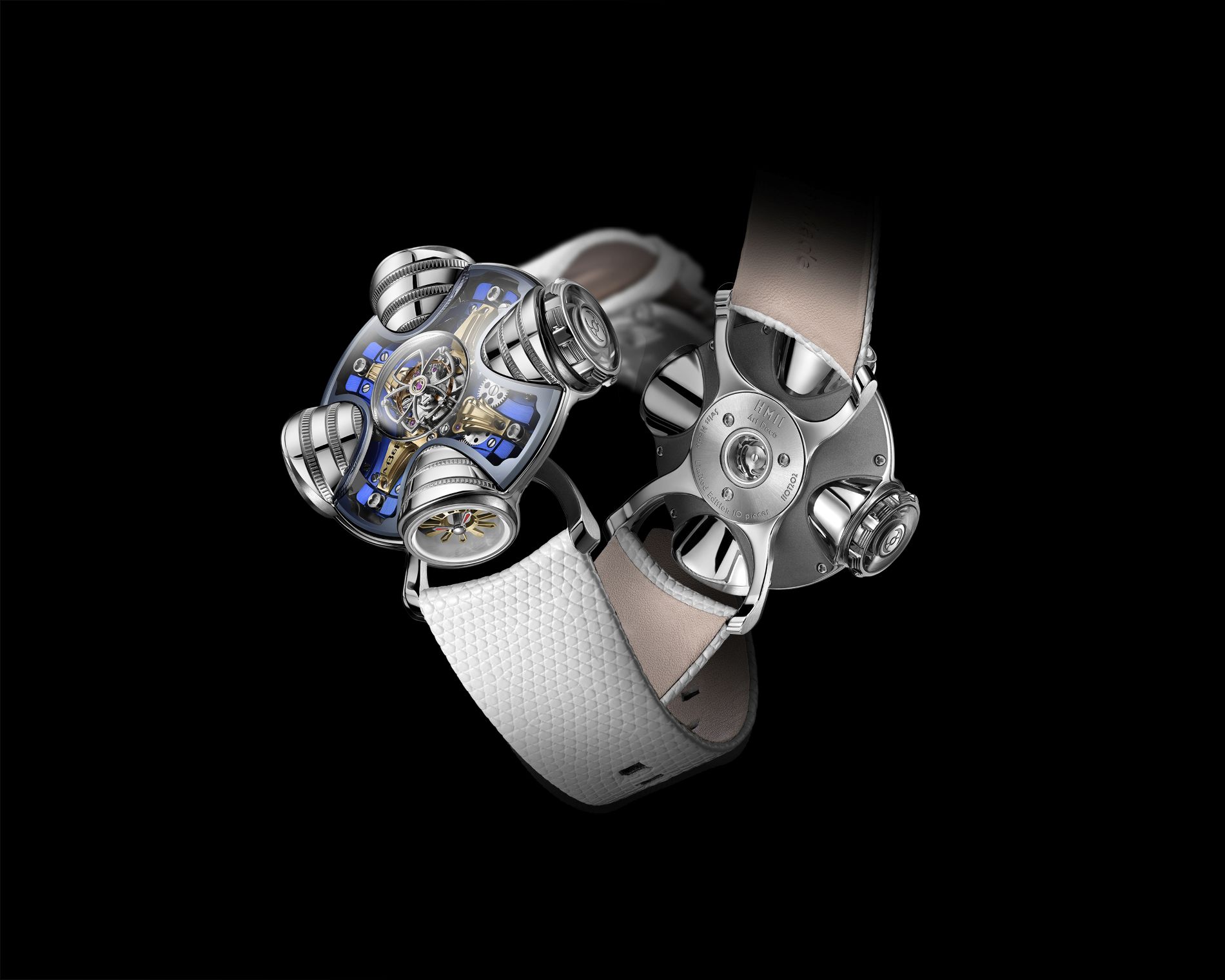
The new HM11 Art Deco builds on the same foundations while adopting a distinct visual language. Guided by Maximilian Maertens’ fascination with early-20th-century architecture – from Parisian cinemas to Manhattan skyscrapers – the design trades the organic fluidity of the Architect for the geometry and rhythm of the Art Deco movement.
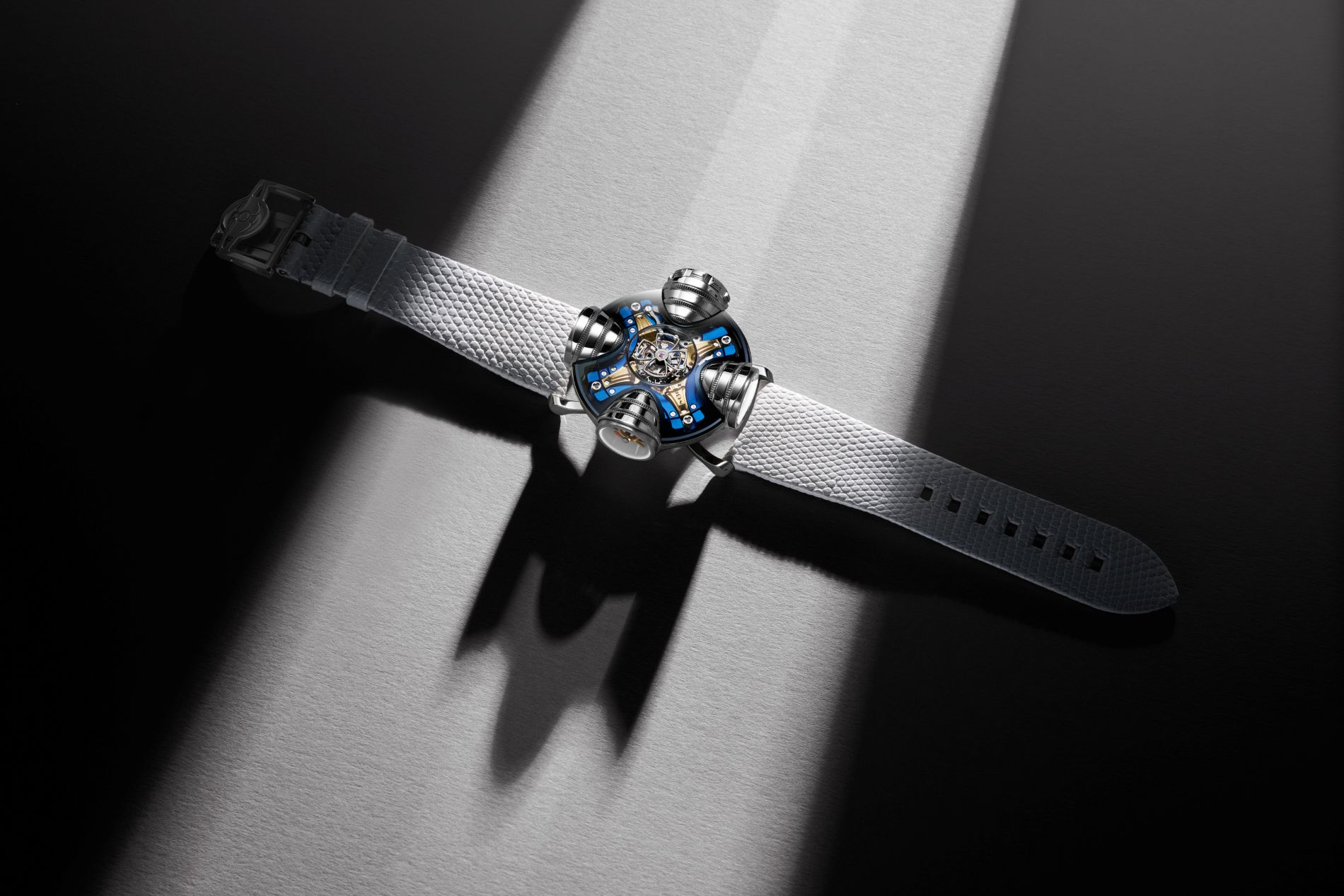
On the dial side, radiating “sunbeam” motifs – partially skeletonised for legibility – replace the original conical rods, while two-tone rings and period-inspired typography define the displays. The hands feature a red stained-glass effect thanks to translucent enamel. The bridges rise in more vertical, architectural forms reminiscent of ornamental stonework, and the roof’s grooved profiles echo the stepped silhouettes of skyscrapers like the Chrysler Building. The re-drawn tourbillon bridge now aligns with the base plate, creating a visual axis that ties the structure together; even the crown gains subtle steps recalling layered poster art. Put together, the modifications reinforce a sense of upward momentum: an Art Deco skyline.
Viewed side by side, the two chapters of HM11 reveal a study in contrasts. The original Architect evokes the soft concrete curves of the 1970s: human, tactile, experimental. The new Art Deco stands upright, structured, graphic: a city in miniature. Yet both share the same spirit: a Horological Machine to be lived, not merely worn.
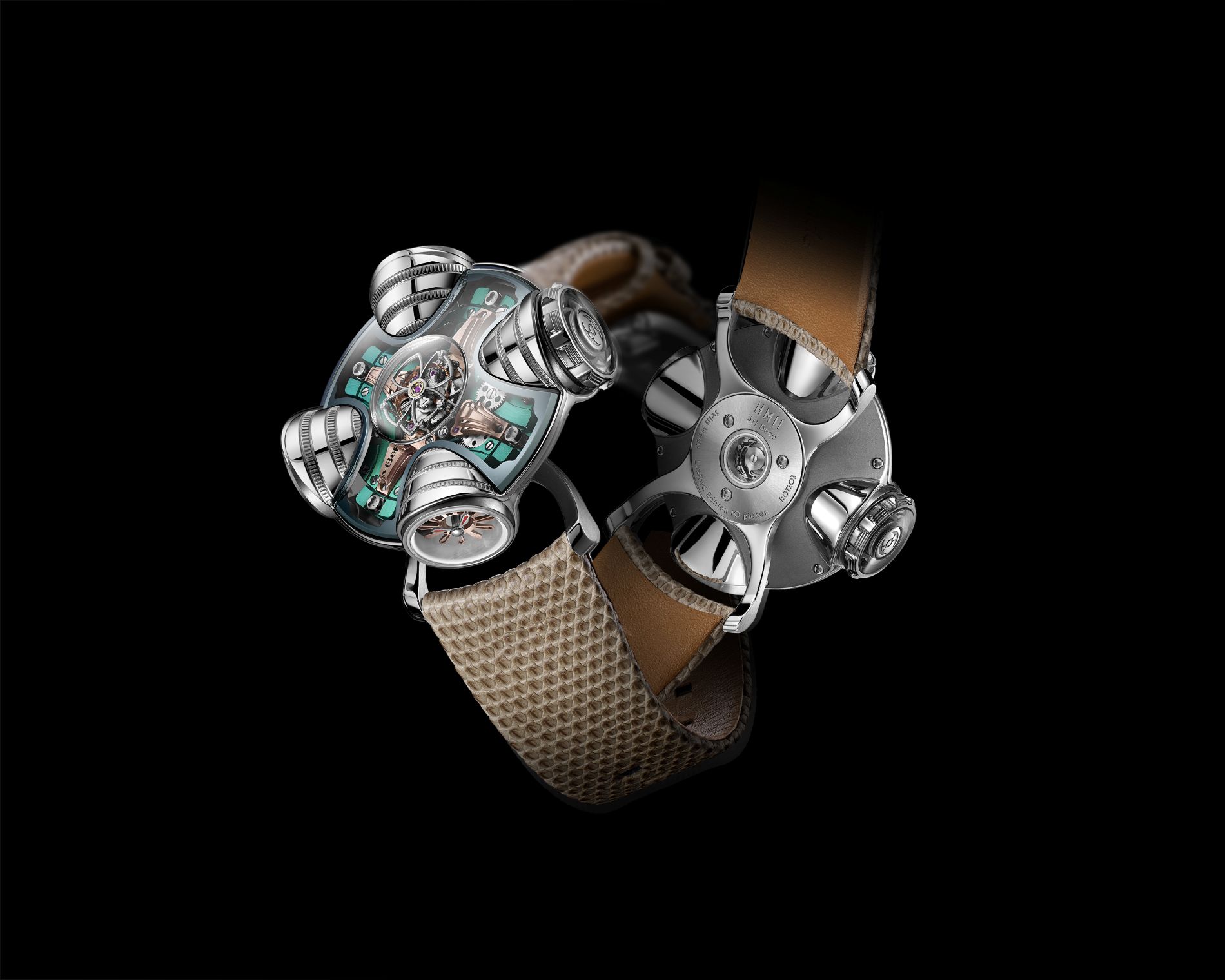
The HM11 Art Deco is crafted in two editions of 10 pieces each, totalling 20 pieces for MB&F’s 20th Anniversary, both in grade 5 titanium:
– Blue dial plate with 3N yellow-gold-toned bridges, paired with a white lizard strap;
– Green dial plate with 5N rose-gold-toned bridges, on a beige lizard strap.
HM11 ARCHITECT & HM11 ART DECO
Blurring the lines between horology and architecture 2023 saw the rise of HM11, a hybrid mixing complex watchmaking and architecture, straight out of the brains of MB&F creative director Maximilian Büsser and designer Eric Giroud; its curves were inspired by the neo-futuristic architecture of the 1960s and 70s. For the 2025 HM11 Art Deco editions, designer Maximilian Maertens has added distinct design elements from the 1930s movement.
HM11 Architect
“A house is a machine to live in”: Le Corbusier’s quote has followed MB&F for years because its Horological Machines are not simply worn; they are inhabited. They invite a person to step into a story, sometimes a different time, sometimes a world that never existed. The first Horological Machine N°11 took that idea and made it literal. The object on the wrist became a small design house, complete with rooms, an atrium, corridors and a front door. The result was not a traditional case with a dial but a micro architecture that happened to keep time.
The introductory HM11 Architect arrived in 2023, but the seed of the design goes back further, to the late 1960s and early 1970s, an era when a few radical architects began shaping buildings organically. They produced houses that looked as if the earth had exhaled them: forms swelled and curved, volumes wrapped around sightlines and limbs. It was human in the most direct way, not through theory but through shape and scale. Maximilian Büsser looked at these organic homes and thought: what if a house was a watch?
The answer became the HM11 Architect. A central flying tourbillon rose under a double domed sapphire roof. Its quatrefoil-shaped upper bridge called to mind clerestory windows. From that centre, four symmetrical volumes reached outward to become the rooms of the house. The four rooms were not metaphors: each one carried a specific function and could be placed either directly in front of the wearer or offset by 45 degrees, simply by rotating the case. Orientation was a choice, not an obligation.
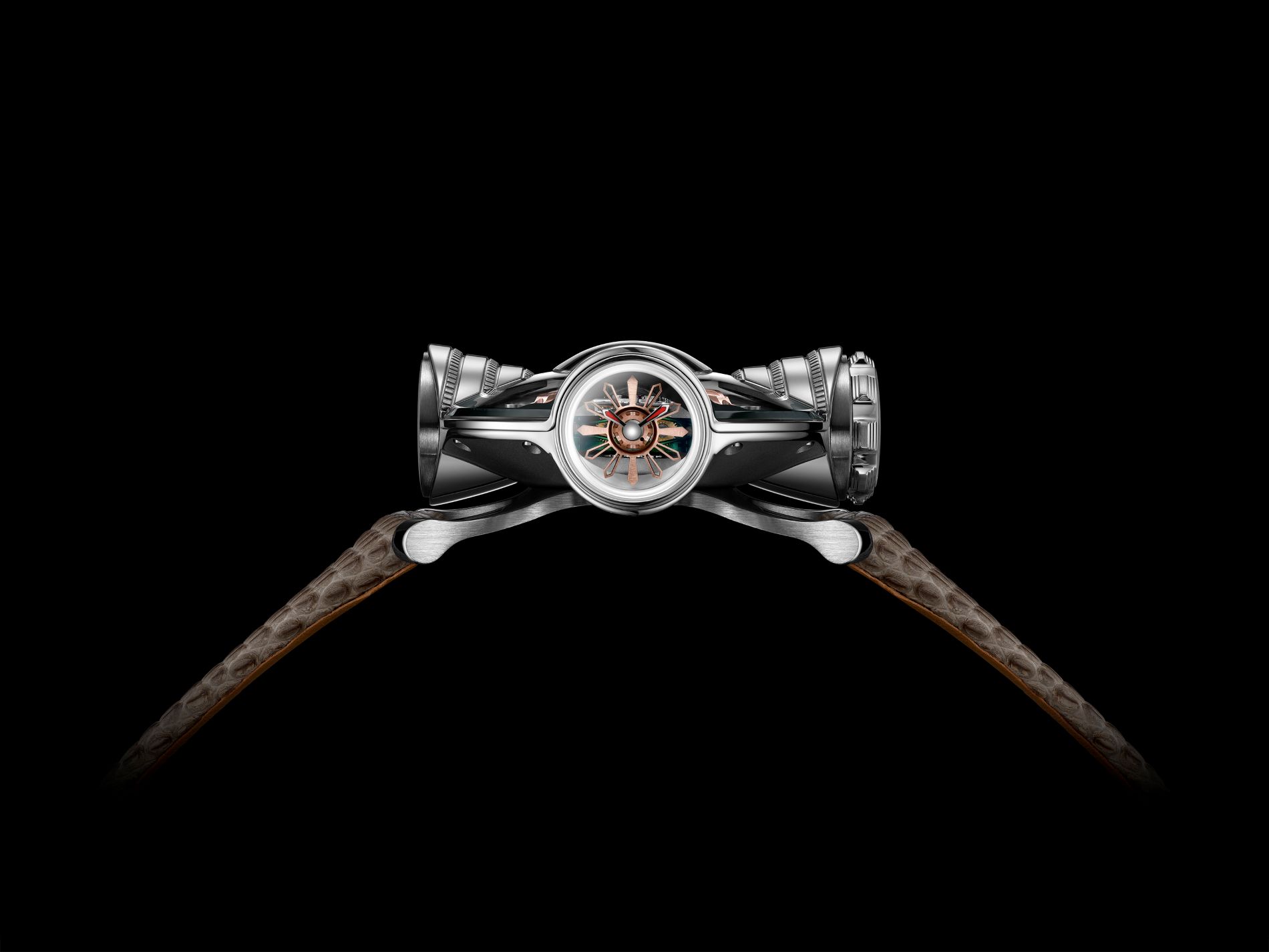
The time room delivered the essential: hours and minutes were displayed with a clarity that felt almost domestic. Rod mounted orbs served as markers: larger and lighter aluminium orbs marked the quarters, while smaller and darker titanium orbs completed the ring. The next room housed the power reserve: five orbs increased in size as the barrel filled, with a polished aluminium orb of 2.4 millimetres indicating full power. Another room installed a thermometer, not an electronic sensor but a mechanical system using a bimetallic strip. The range covered -20 to 60 degrees Celsius, or zero to 140 Fahrenheit, as preferred by the owner. The final room looked empty, a void with a small badge carrying the MB&F battle axe emblem. That quiet space was the time setting module. Pulling the transparent unit opened the door with a click,turning it moved the hands. The crown was the key to the house.
Winding did not happen at the crown, but thanks to the entire case turning on its foundations. Each 45-degree clockwise rotation clicked under the fingers and delivered exactly 72 minutes of power to the barrel. Ten complete turns produced the full autonomy of four days (96 hours). The sensation surprised many first-time wearers: the act of winding became a twist of an object rather than the tiny movement of a fingertip. The bond between owner and machine deepened through touch. It felt playful, and at the same time it felt precise.
The 42mm case itself showed how far the house metaphor could go. Grade 5 titanium formed the outer walls of the rooms. The atrium opened to the light beneath a transparent roof built from two stacked sapphire crystal domes. The crown was sapphire as well, nearly ten millimetres across, an unprecedented feature that required special engineering. A crown of that size cannot rely on a single oversized gasket, since friction would make it unusable. The solution stacked seals like a double airlock. A total of eight gaskets supported the crown alone; adding the gaskets around the case and bezel increased the count to nineteen.
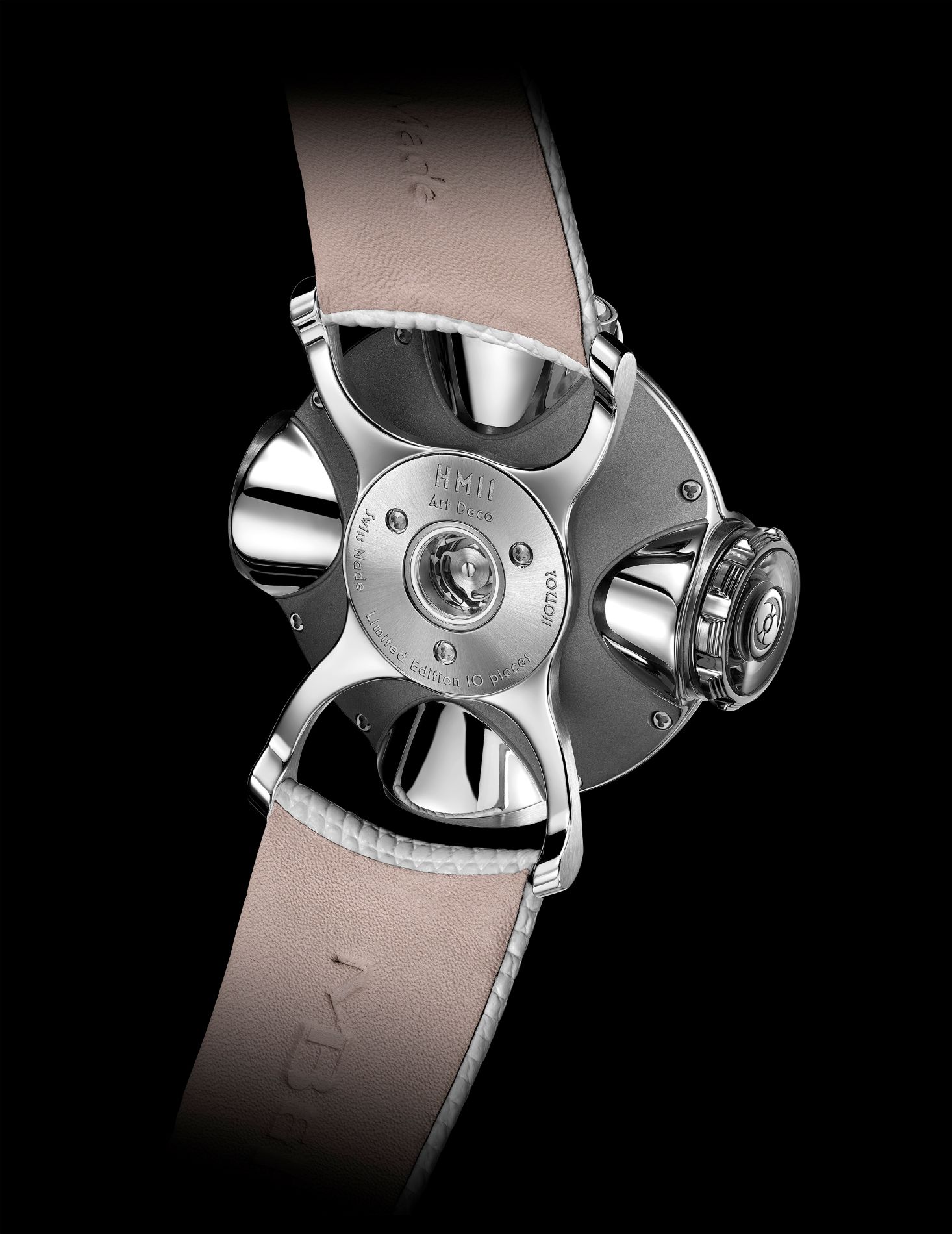
The engine under the roof was an in-house manual movement, three-dimensional in its construction and built around bevel gears. The flying tourbillon set the cadence at 2.5 hertz, or 18,000 vibrations per hour. A system dampener isolated the movement from shocks through four high tension suspension springs hidden between the engine and the lower shell. These were not simple wire coils but custom elements laser cut from a hardened steel tube with a chrome finish, a solution derived from aerospace technology.
The first HM11 launched in two editions with plates and bridges in ozone blue or rose gold tones, each limited to 25 pieces. The sense of a new species was unmistakable. On the wrist the object looked like architecture. In the hand it felt like a 1970s spaceship.
HM11 Art Deco
The next step is not a departure but a change in language: the HM11 Art Deco introduces a different voice while keeping the same foundations. The person responsible for that voice is Maximilian Maertens in Berlin. His route into the era was not academic: at sixteen he visited the Rex cinema in Paris and noticed how that building stood apart, in a city where so many entrances and façades lean toward Art Nouveau. That memory lived somewhere close and eventually became a compass point for this design.
The brief that followed was clear: evolve the Architect without losing its identity.
Art Deco arrives in HM11 through structure and graphics. The dial side adopts a two-tone logic that separates rings and fields. Displays change from the initial conical rods to radiating sunbeam motifs typical of the posters from the period. The temperature display switches to a font linked to the era. The metalwork makes the message physical: bridges visible from above gain a more vertical, block-like stance; their profiles recall ornamental stonework and the measured cadence of façades. On the case, the small roof elements are reworked with fine grooves that echo the stepped profiles of skyscrapers such as the Chrysler Building. Viewed from above they feel like miniature towers; viewed in passing they introduce a vertical rhythm that sits comfortably with the sunbeam dials.
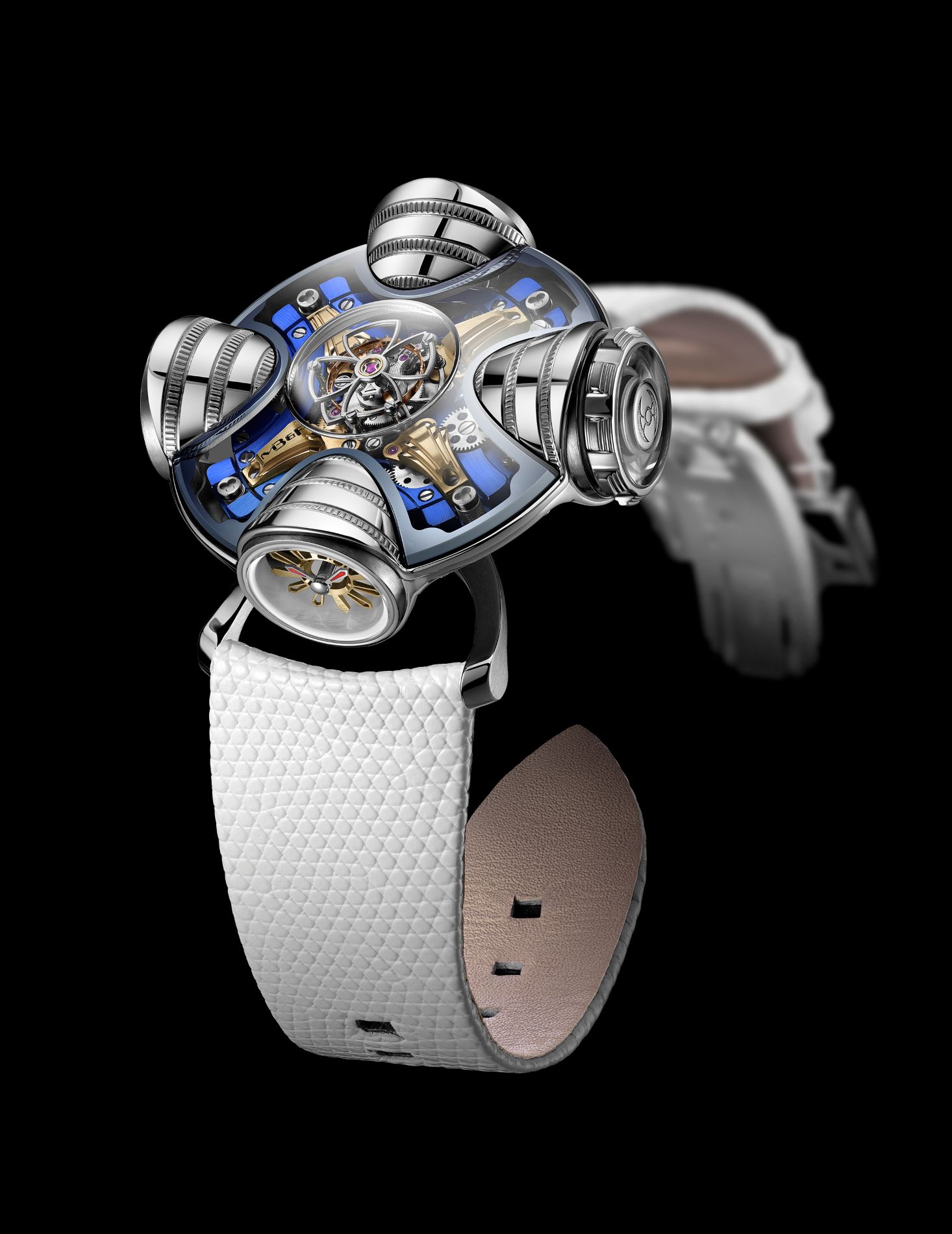
The tourbillon bridge has been redrawn so its axis connects with the larger base plate bridges: when alignment lands exactly right a clean line reads across the object and ties the architecture together. The crown gains small steps that mirror layered poster art. The changes are subtle but illustrate the approach throughout this new chapter: make many small decisions, and let the sum of them support the idea.
The difference between the two HM11 chapters becomes obvious when the watches sit side by side. The Architect feels like freshly sprayed concrete with gently rounded forms, organic and experimental. The Art Deco stands straighter and speaks in verticals and sunbeams, structured and graphic. The first reads like a humanist experiment; the second reads like a city rising, with towers and façades translated to millimetres and microns. Both share the same foundations, and both tell stories that place the wearer somewhere specific. Both are machines built to be lived.
The two new HM11 Art Deco editions are in grade 5 titanium and limited to only 10 pieces:
– with blue dial plate and 3N yellow gold toned bridges, paired with a white lizard strap;
– with green dial plate and 5N rose gold toned bridges, paired with a beige lizard strap.
HM11 Art Deco in more detail
A pair of short stories explains how certain design decisions took shape; the first concerns the dial frame. Early prototypes used a full ring with no openings. Once assembled, orientation suffered: noon, three, six, and nine were not immediate. The solution was to turn the frame into a skeleton and open specific apertures with a laser. After cutting, the space left on each hand measured around two tenths of a millimetre – roughly the thickness of two human hairs. Repositioning and indexing had to be exact. The production order was adjusted so that the risky step came before final finishing, not after. The frame then received diamond cut accents, micro blasting, and a circular satin finish. The look stayed crisp and the reading became clear.
The second story sits in the hands. The designer asked for a red stained-glass effect. Rubies were considered, but the geometry could not be made to work in that shape. Transparent enamel became the path forward. Dozens of trials established a shade that reads under direct light and with light shining through from behind. The look is slightly milky and clearly translucent. Across the watch there are four hands. Each one differs slightly to respect the intended graphics of its display.
Much of the work in the HM11 Art Deco editions is finishing. The upper cage bridge concentrates many inward angles; these are finished by hand and only a few specialists achieve them cleanly and consistently. The lower cage bridge mirrors the same drawing. The four peripheral bridges alternate polished and satin faces in sequence so light walks across the surfaces. In a render the effect almost vanishes; in person it becomes the first thing the eye tracks as the wrist moves.
Glass elements deserve a moment of attention. Each groove is cut with a specific tool. Larger grooves are taken by hand to erase machining marks. A very dark anthracite metallisation hugs the edges of the glass to hide gaskets and structural parts, a technique that already proved its worth on the first HM11 and continues to do so here. The underside of the case remains micro blasted for a calm, even tone. The upper areas alternate polish and satin in a pattern set by the new graphics. The stepped outer ring is the visible change that ties the theme together.
None of those choices change the way the machine runs; the challenge sits in manufacture and finishing. The case stays grade 5 titanium, sapphire crystals cap the top and back and cover each chamber display, with antireflective coatings on both faces. Water resistance stays at 20 metres. Inside, the manual movement developed in house runs at 2.5 hertz and stores 96 hours. Winding still happens by rotating the entire case. The functions remain hours and minutes, power reserve, and temperature.
A short note on comfort helps complete the picture. Despite its three-dimensional complexity, the case sits compact at 42mm. The curved feet that double as strap attachments spread the load and add stability during winding. The titanium shell keeps weight down.