
Chopard Manufacture in Fleurier celebrates its 30th anniversary with its most complicated chiming watch to date
From the workshops of Chopard Manufacture comes the new L.U.C Grand Strike, an opus of mechanical mastery developed entirely within the walls of the Swiss watchmaker. This exceptional chiming timepiece, featuring a grande sonnerie, petite sonnerie and minute repeater with proprietary sapphire crystal gongs, represents the culmination of the Maison’s mechanical expertise and a decades-long sonnerie journey initiated by Karl-Friedrich Scheufele, Co-President of Chopard.
The result of over 11,000 hours of focused research and development, the L.U.C Grand Strike draws on ten proprietary technical patents – five of which were newly developed for this timepiece – making it the most complex watch ever created by Chopard Manufacture. Its performance is assured by rigorous in-house tests as well as certifying bodies such as the Poinçon de Genève, and the Contrôle Officiel Suisse des Chronomètres (COSC). With these certifications, the L.U.C Grand Strike is officially the most comprehensively rated grande sonnerie among contemporary high complications.
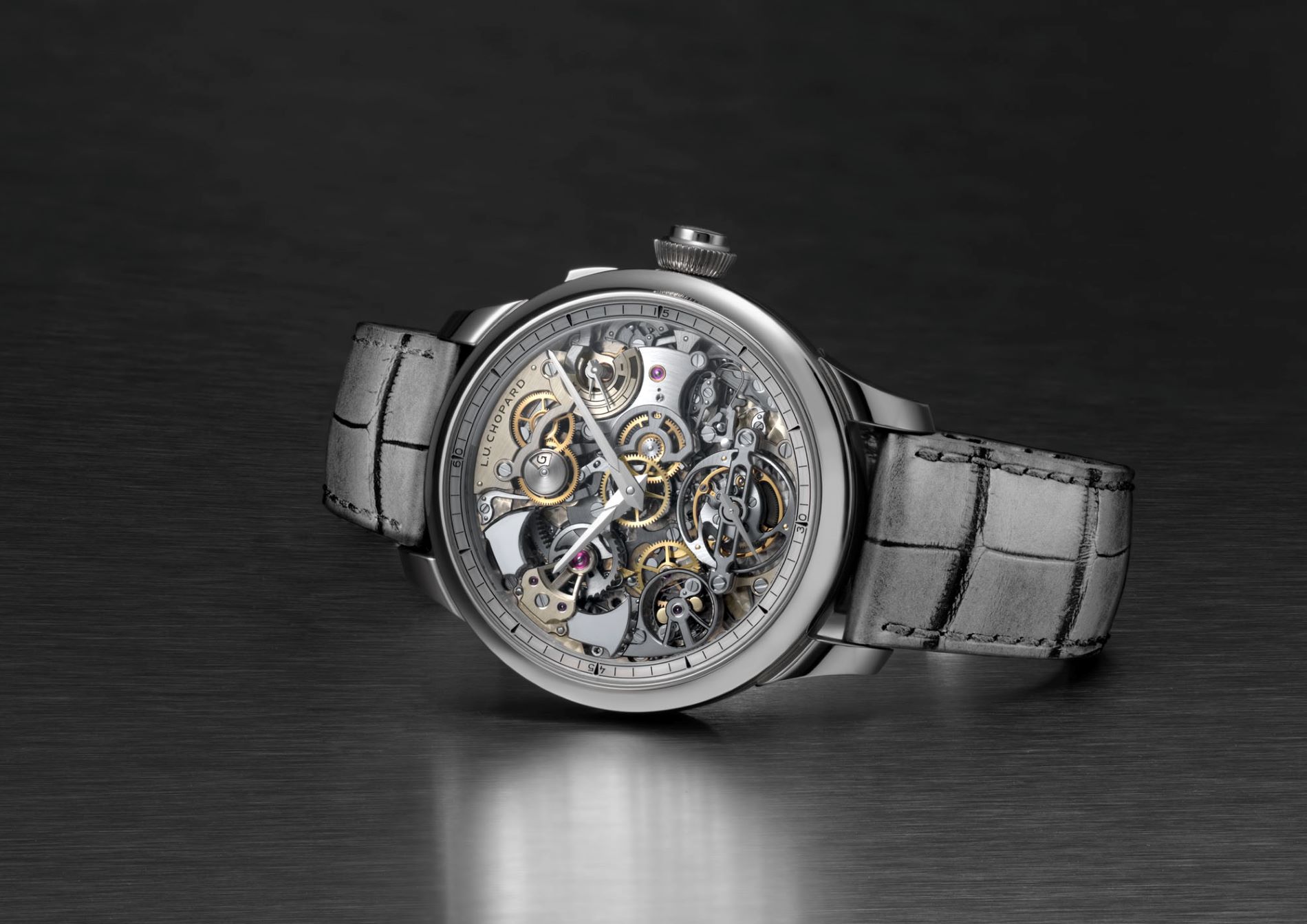
The design of this timepiece is a blend of traditional forms with modern aesthetics, combining understated curves with a dial-less display that puts the 686-component calibre L.U.C 08.03-L in the spotlight.
“It has always been our intention to conceive a grande sonnerie at Chopard. If you look at the L.U.C Grand Strike, what you see is the cumulative impact of 30 years spent creating and innovating in the domain of fine watchmaking. When you listen to its chime, you are hearing the rhythm of Haute Horlogerie at Chopard Manufacture. If the chime moves you, it’s because you resonate with our way of making watches” explains Karl-Friedrich Scheufele.
The culmination of three decades of innovation
The L.U.C Grand Strike is rooted in nearly 20 years of sonnerie expertise at Chopard Manufacture – and 10 years of sapphire monobloc technology – comprising 686 movement components in the most complex watch created in the history of the Manufacture. Over 11,000 hours were invested in this project, from the very first exploratory studies to the creation of technical plans and the production of a working prototype. Over 2,500 of those hours were dedicated to fine-tuning the prototype, ensuring the final production pieces are poised at the limits of micro-mechanical perfection.
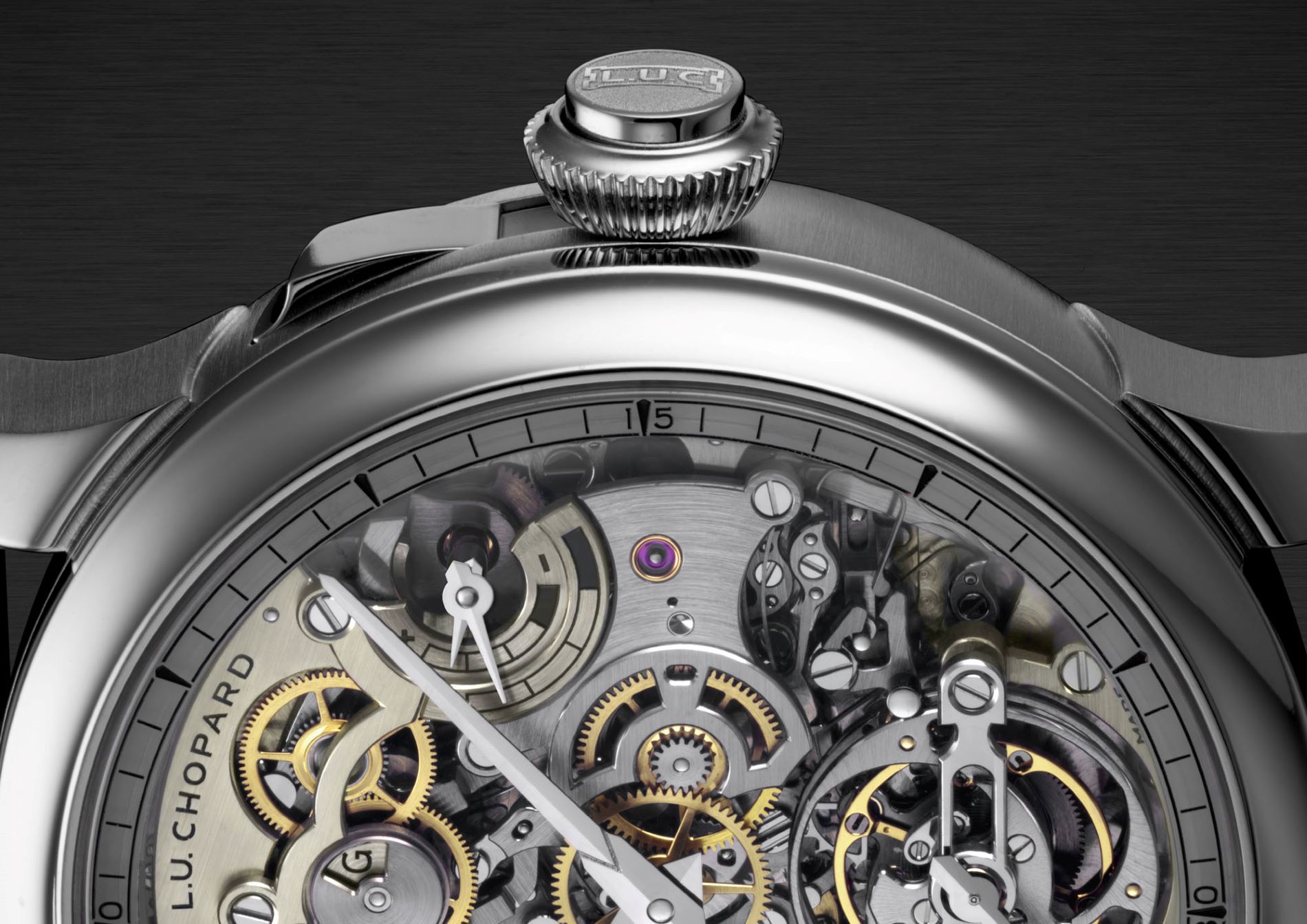
Housed in a remarkably compact 18-carat ethical white gold case measuring 43mm in diameter, the restrained curves and profile of the case design draw the eye directly towards the high precision L.U.C 08.03-L calibre, which is fully visible thanks to the open dial. At the 10 o’clock position, two polished steel hammers clearly indicate the chiming nature of this watch, which can be adjusted to three sonnerie modes – Grande Sonnerie (G), Petite Sonnerie (P), Silence (S) – via an ergonomically designed sliding selector switch located next to the winding and setting crown.
The lower half of the watch dial is occupied by a 60-second tourbillon, a visual reminder of the COSC-certified performance of the movement. Between the continuous rotation of the tourbillon and the motion of the chiming mechanism, the L.U.C Grand Strike offers its wearer an immersive experience of mechanical wonder with every glance.
A hallmark of watchmaking excellence and innovation at Chopard, the patented sapphire crystal gongs are machined in one single unit with the dial. This unique gong construction, using the horologically unprecedented material of sapphire crystal, is what gives the L.U.C Grand Strike its matchless acoustic character.
Apart from the sapphire crystal gongs, an additional nine patents filed and/or granted have been employed in the creation of the L.U.C Grand Strike, demonstrating once again the spirit of innovation that defines Chopard Manufacture. These patents cover all aspects of function in this watch, from important security mechanisms that protect the movement against accidental mishandling, to improvements in chiming cadence. Five of these patents are new filings that were specifically developed for the L.U.C Grand Strike, representing the continual evolution of innovation-driven expertise at the heart of the Maison.
Throughout its years of development, the L.U.C Grand Strike was conceived with the harmonious and simultaneous integration of both its technical and aesthetic aspects. The final watch is a triumph of this approach, blending horological mastery seamlessly with design elegance.
Composing a legacy of sound
At the opening of the new millennium, Chopard Co-President Karl-Friedrich Scheufele led the Manufacture on its first steps into the domain of chiming watches, making the L.U.C Grand Strike an inevitable part of Chopard’s destiny. Barely a year after the 2006 launch of the L.U.C Strike One, he began to discuss the possibility of Chopard’s very own grande sonnerie movement with the Research and Development team.
Acquiring the in-house skills to create such a horological colossus was an ambitious objective all on its own, but it was just as important that Chopard should achieve more than expertise — it should achieve mastery. Which is to say, to go beyond impeccable execution and move towards true innovation.
The genesis of the L.U.C Grand Strike can be traced via the traditional high-complication pieces such as the L.U.C All-In-One (2010), as well as the avant-garde approach of the multi-patent L.U.C 8HF (2012). These pieces showcase the versatility of Chopard Manufacture across the wide spectrum of watchmaking approach, from true classicism to the uncompromisingly contemporary.
Each of the intricate mechanical systems that together form the calibre L.U.C 08.03-L has been implemented with a profound understanding and familiarity with every aspect of mechanical watchmaking. The multi-barrel construction that underpins all sonnerie watches was enhanced by the knowledge gained through creating virtuoso timepieces with advanced power distribution systems such as the four-barrel L.U.C Quattro. The L.U.C Grand Strike’s 60-second tourbillon owes its strict performance standards to the in-house experience acquired through the L.U.C 02 family of tourbillon movements. Even something as expected in watchmaking norms as the instantaneous sonnerie activation has been refined with the insights derived from building complex calendars such as the L.U.C Lunar One, with its jumping displays.
In 2016, the L.U.C Full Strike minute repeater further demonstrated the Manufacture’s commitment to the pursuit of the perfect chime. Not only did it highlight the evolution of sonnerie expertise at Chopard, it also introduced new horological knowledge to the world. For the first time in watchmaking, a chiming watch struck the hours, quarters and minutes on gongs of sapphire crystal instead of steel.
The acoustic properties of sapphire crystal, technically known as monocrystalline aluminium oxide, had long been known. Its delicate nature, however, led to the consensus in the watchmaking community that sapphire crystal gongs were too impractical to even attempt. That is, of course, until Chopard Manufacture took up the quest and succeeded where no one else had before.
Ultimately, the L.U.C Full Strike proved the impossible possible and was awarded the highest honour at the 2017 Grand Prix d’Horlogerie de Genève (GPHG) — the prestigious Aiguille d’Or.
The calibre L.U.C 08.03-L: a crescendo of complications and patents
Today, Chopard reveals another chapter in its sonnerie journey: the L.U.C Grand Strike. It features the most exalted of chiming complications, a grande sonnerie, which strikes the full complement of hours and quarters as they pass. The watch can also be switched to the less chime-intensive petite sonnerie mode, which strikes the hours only at the 60-minute mark, and solely the quarters every 15 minutes thereafter. If wished, the automatic chime of the L.U.C Grand Strike can be entirely silenced, and the watch will strike the time only when its minute repeater function is manually activated.
Upon each manual (minute repeater) or automatic (grande or petite sonnerie) activation of the chime, 34 components leap to attention, poised to deliver a clear and precise report of the time. Guided or retained by an array of 22 hand-adjusted blade springs, these 34 components require only 0.03 seconds to go from standby to being ready for action: a perfectly coordinated corps de ballet supporting their principals in the spotlight, the hammers and gongs. In the mechanical dance that follows, levers descend, cams extend and racks advance — all leading up to the final moment when hammer meets gong and sonic beauty erupts.
A total of 686 movement components is required to animate the panoply of chronometric functions in this timepiece, which also includes a 60-second tourbillon. The latter is topped by a small-seconds indicator, as a continuous but subtle sign of the timekeeping precision built into this watch. The L.U.C Grand Strike is doubly certified, bearing the quality hallmarks of the Poinçon de Genève and the Contrôle Officiel Suisse des Chronomètres (COSC).
Ensuring that the watch can still perform even at the limits of the movement’s energy demands, the L.U.C Grand Strike was awarded COSC certification when tested in petite sonnerie mode. While the petite sonnerie may appear to be more energy efficient than the grande sonnerie, in reality it has a higher energy threshold than the latter complication. This is due to the mechanism that suppresses the hour strikes at the quarter hours, which acts as a brake on the chiming system and effectively shortens the power reserve.
Despite the sheer number of components in the L.U.C Grand Strike and its full range of chiming complications — not to mention the tourbillon and underlying timekeeping functions — the watch diameter is only 43 mm, and its height is a modest 14.08 mm. A minor miracle in contemporary watchmaking, and an essential feature in modern life, which demands efficiency of dimension and energy.
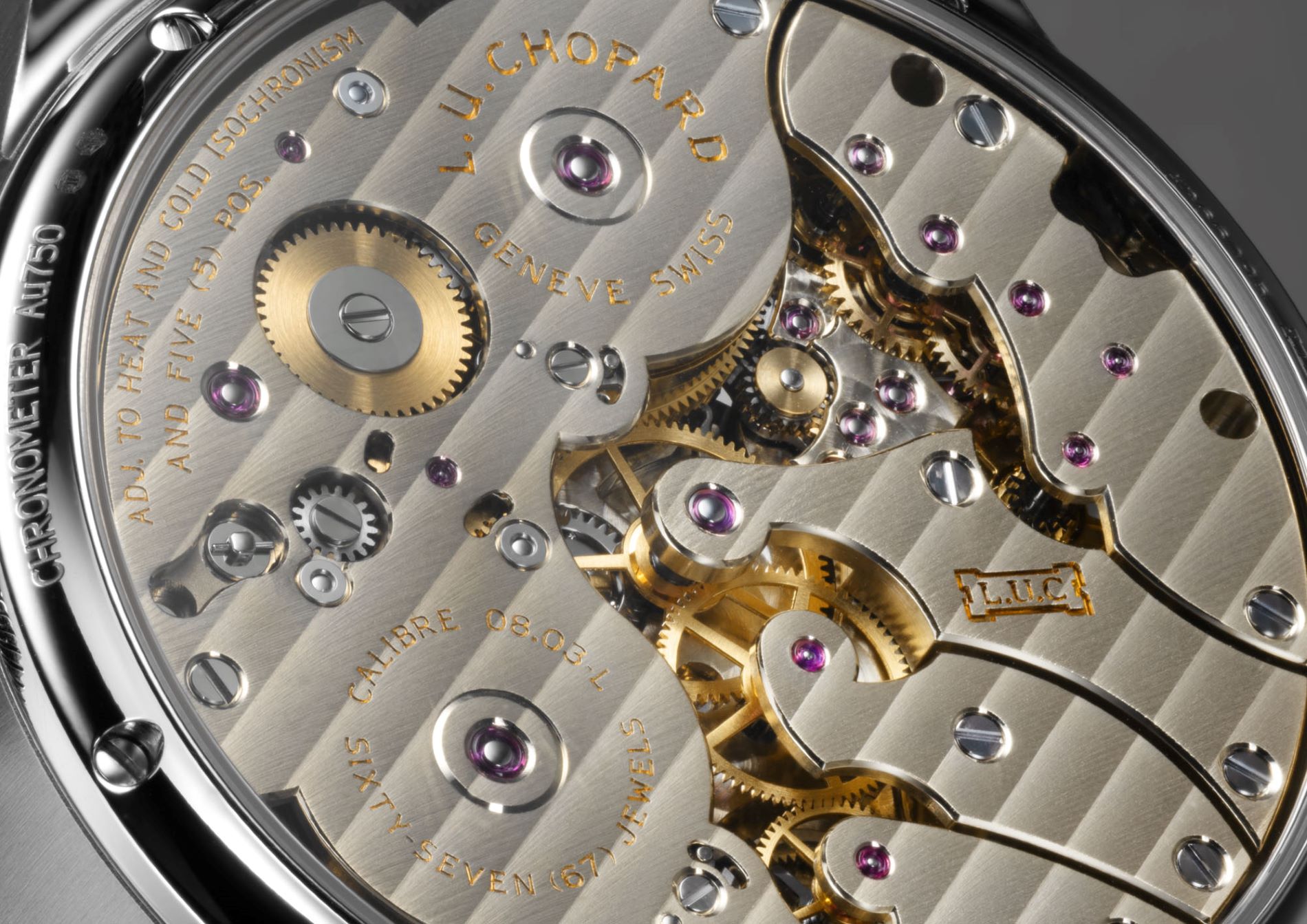
To meet the latter requirement, the in-house manual-winding calibre L.U.C 08.03-L possesses two mainspring barrels, one for the timekeeping functions and another separate barrel for the chiming complications. When fully wound, the sonnerie barrel provides 12 hours of uninterrupted function when in the chime-intensive grande sonnerie mode.
The main power reserve of 70 hours is also noteworthy for such a highly complex watch, especially considering its balance frequency. The L.U.C 08.03-L beats at 4Hz (28,800vph), which is standard for a sports watch, but considered high for a complicated watch of this level. By not making any concessions and keeping the L.U.C Grand Strike within the strict performance expectations of any other modern wristwatch, chronometric quality is guaranteed.
This precision is supported by the system of time indication itself, which features a stop-seconds function. When the crown is pulled out and in its time-setting position, the small seconds hand is braked, allowing the time to be accurately set to the second. In this way, the chronometric capabilities of the movement can be fully expressed via the dial indications.
On top of its superb chronometry and display performance, the L.U.C Grand Strike has also been built to withstand the test of time. From as early on as the prototype stage, the in-house quality control of the L.U.C Grand Strike at Chopard Manufacture involves 62,400 activations of the sonnerie (half in each sonnerie mode) in an accelerated process that simulates five years of wear in just three months. In this time, the minute repeater is also continuously activated via the crown-pusher — 3,000 times to ensure the movement can stand up to prolonged use. All in all, the sapphire crystal gongs are struck over half a million times during this rigorous testing, demonstrating the resilience of the in-house calibre L.U.C 08.03-L.
A crystal-clear sound
While the foundation of the L.U.C Grand Strike lies in the decades of watchmaking patrimony integrated within Chopard Manufacture, its core is defined by innovation. To bring greater precision and expertise to the process of creating sonnerie watches, Chopard worked closely with an engineering university in Geneva, the Haute Ecole du Paysage, d’Ingénierie et d’Architecture (HEPIA) to analyse the technical characteristics of its signature chime. These observations can be attributed to three key differences that separate the sapphire crystal chiming system from its technical predecessors utilising steel gongs.
Firstly, there is its monobloc construction. Conventional chiming watches use polished steel gongs with a round cross-section, fixed to the movement with screws. The traditional sonnerie chime is produced when hammers strike the gongs, causing them to transmit acoustic energy in the form of vibrational waves throughout the watch, travelling through the dial crystal and propagating sound through the air. This indirect method of sound transmission results in energy loss at several points, via the gong attachments, the movement and even the case itself, elements which dampen the overall chime. Chopard’s proprietary chiming system combines the gongs and dial crystal, which are machined out of a single piece of sapphire crystal. When the sapphire crystal gongs are struck, they vibrate in concert with the dial crystal, channelling the sound directly towards the exterior of the watch and avoiding energy dissipation through the movement or case. Naturally, the chime gains in clarity and tonal purity.
Secondly, there is the geometry of the sapphire crystal gongs. Instead of the round cross-section seen in traditional steel gongs, the sapphire crystal gongs have an orthogonal (square) cross-section. Solidly based on the principles of kinetic energy transmission, this allows for an increased area of contact between the sonnerie hammers and the gongs. In addition to this
greater potential for efficient energy transfer, gongs with a square cross-section also come with acoustic properties that set them apart from gongs with a round cross-section. The right angles along the length of the gong serve to channel and direct sound waves into distinct modes of vibration, comparable to how polarised lenses can channel and direct wavelengths of light. This complex vibrational pattern effectively creates a rich, layered chime that is simultaneously harmonious and textured to the ear.
Thirdly, the atomic structure of sapphire crystal itself gives all Chopard sonneries currently in production their unmistakeable quality. Ethereal yet powerful, brilliant and resonant, the chime generated by the monocrystalline structure of these gongs is unmatched by any steel equivalent. The exceptional hardness of sapphire crystal (second only to diamond) also ensures that, unlike metal, it cannot be physically deformed. Hence its characteristic sound, named the Sound of Eternity.