
Ever since 1963, when Piaget dared to dress watch dials in vibrant ornamental stones such as lapis lazuli, turquoise, malachite or tiger’s eye, the Maison has been famed for its wayward way with colour, an essential element of Extraleganza. Unexpected jolts of bold colour, of pop-art-inspired mother-of-pearl and onyx, or modernist, graphic compositions of lapis lazuli and jade, intensified the shock of the new delivered by Piaget’s milestone launch in1969 of the 21st Century Collection, which transformed the jewellery watch into a contemporary artwork and a cultural icon.
Now, for 2026, as Piaget delves even deeper into its heritage, connecting past and present times, to renew its creative spirit of timeless modernity, the Art of Colour is reignited, through an exploration of new and intriguing varieties of ornamental stones, set in characteristically audacious style throughout the year’s new timepieces.
The story of colour
Piaget’s fascination with ornamental stones began in 1963, when Gérald and Valentin Piaget, grandsons of the founder, Georges-Édouard Piaget, were in the process of transforming the Swiss company into an international Maison, with a modern, fashion-forward approach, specialising in both jewellery and watchmaking. A process made possible by the decision taken in 1957 to work only in precious metals and materials, and the invention of the groundbreaking 9P ultra-thin movement, which liberated design and creativity. This revolutionary movement meant that dials could be larger and then adorned with ornamental stones while maintaining the watch (legendary) thinness. The dial became the decorative focal point of the design, claimed by Piaget as the new territory of creative expression.
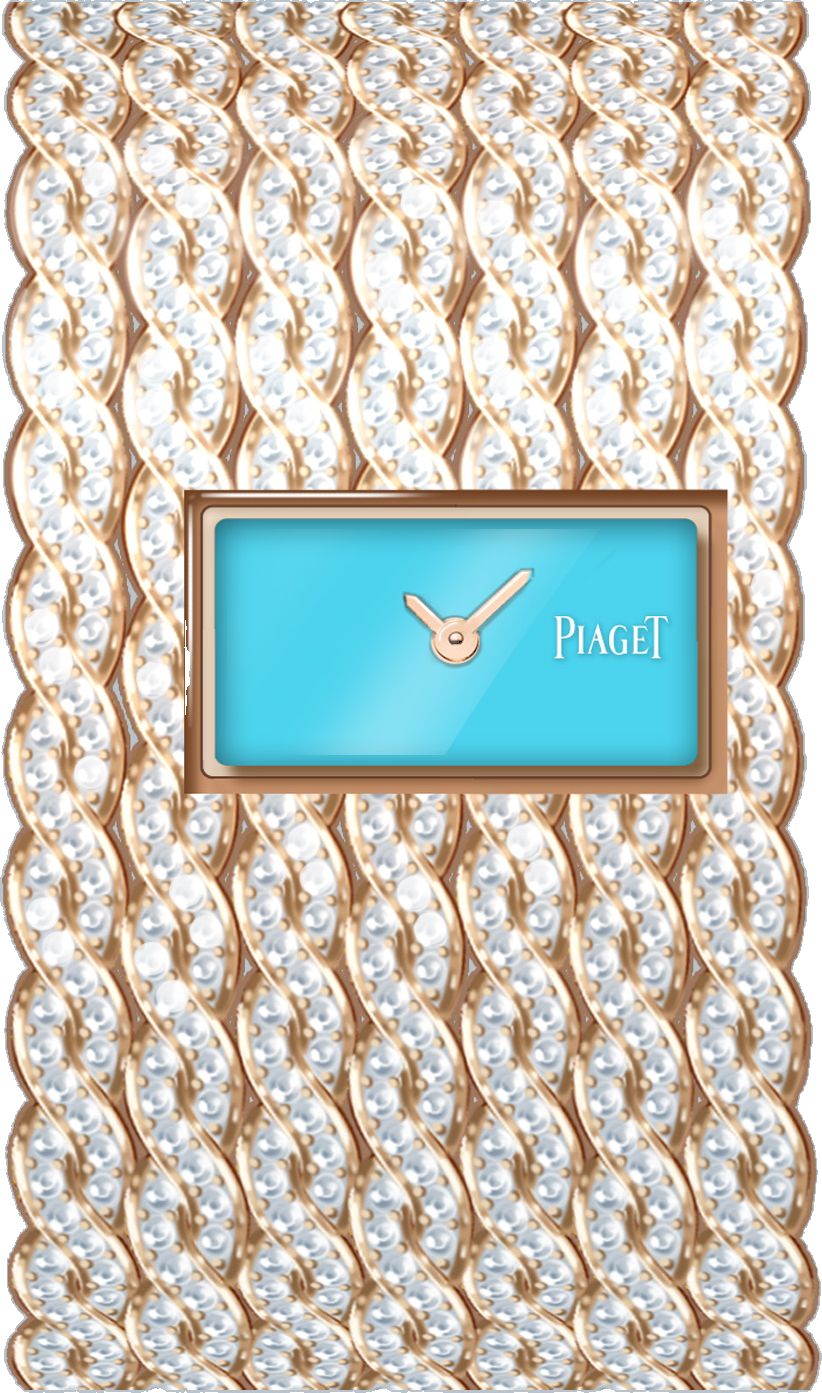
In 1963, Piaget launched a series of gold jewellery watches with dials of ornamental stones, for both men and women, at a time when fashion was alive with colour, with youth-fuelled exuberance and the influence of art was everywhere. This was a bold pioneering move, especially as at the time most watchmakers were turning to steel, to democratise and broaden their markets, and Piaget was elevating the timepiece into a jewelled object of desire. The gold bracelets of the new watches, jewels in their own right, were meticulously hand-crafted by the skilled artisans of the House of Gold, as Piaget came to be known. They could be intricately woven from gold strands, becoming as supple as silk, or textured with hand-engraving, particularly of the one now named Decor Palace, in harmony with the ornamental stones.
Gold, glamour and the cult of distinction
As it turned out, Piaget’s timing was perfect; the new watches captured the mood of the moment, anticipating and responding to the dramatic social and cultural shifts that were to define the 1960s and 70s. The casual opulence of the watches, their nonchalant richness, the freedom from formality, all catered to the tastes of a younger, newly-wealthy, luxury-loving clientele, including the media, art and movie-world celebrities who were to become members of the Piaget Society, Yves Piaget’s international circle of famous jet-set friends. At the same time, ornamental stones, with their natural markings, exuded an earthiness that chimed with the prevailing interest in the natural world. There was a touch too of the otherworldly or supernatural about their wondrous primal beauty that resonated with the futurism of the ‘60s.
The success of these models encouraged Piaget to pursue their pioneering path of innovation and ingenuity. The variety of ornamental stones enabled the Maison to open the door to personalisation, once again anticipating the cult of individuality that dominated the late 20th century design world. The Style Selector, introduced in the mid-1960s, offered a demi-bespoke service, allowing the client to compose her own jewellery watch, from a choice of gold bracelet, a dial either in gold or in one of the ornamental stones – tiger’s eye, lapis lazuli, malachite, opal, mother-of-pearl, coral, rhodonite or ruby root – and different styles of roman or Arabic numerals. Finally, there was a choice of cut and size of the diamonds for the bezel encircling the case and dial.
Since then, Piaget’s art of colour has continued to gather momentum, along with its mastery of skills, of cutting, slicing, polishing ornamental stones. Exceptional skill and mastery of material and technique are required to cut the stones to the required thinness (down to 0.4 mm) and precision of form, and then polish them to a glossy sheen, to bring out the individual markings; the jeopardy in the process means there is a high risk of breakage.
2026, a living legacy
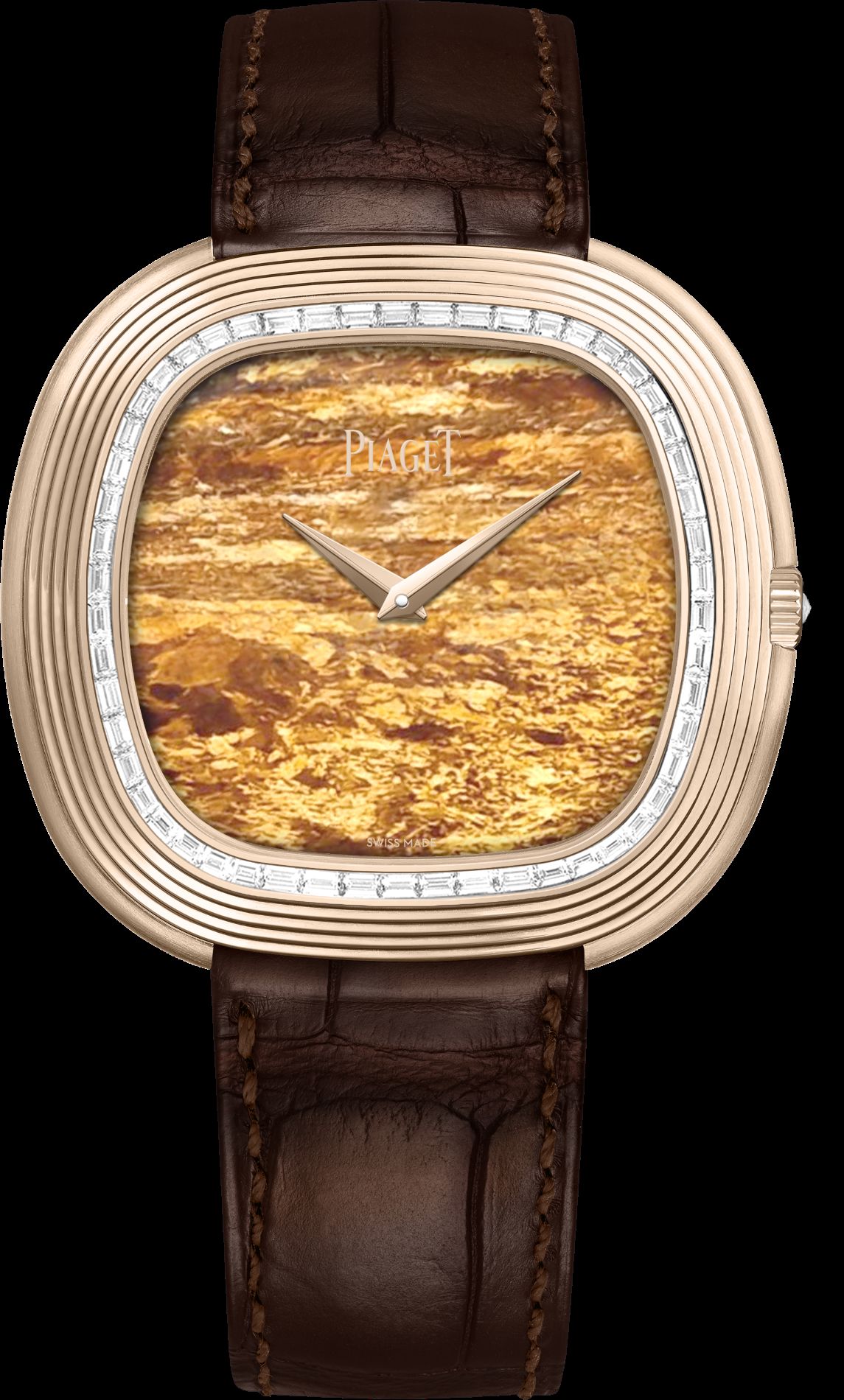
Today, Piaget’s Art of Colour shines out through three striking colourways that connect to the Maison’s history. On one side, the shades of blue, a tribute to Piaget’s signature colour, which now adorn the Sixtie on a strap, the Piaget Polo 36mm in pink gold or the Andy Warhol watch with a set of blue quartz dials. Another Andy Warhol model, sought-after collector’s item, offers a choice of dial and case: a warm, reddish brown bull’s eye, with shimmering chatoyancy, in a studded Clou de Paris case, launched in 2024 in a white gold version.
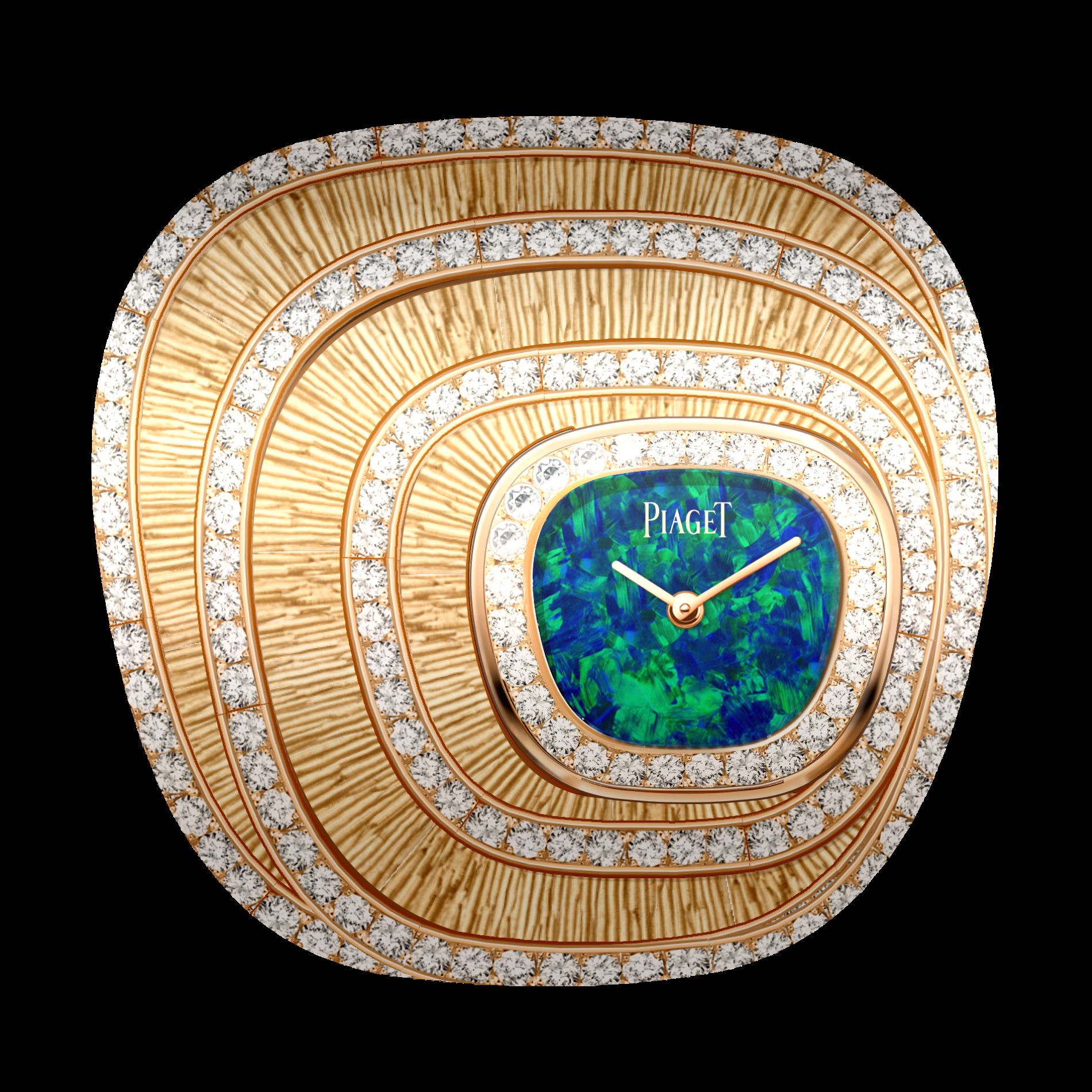
Following the reintroduction of the cuff watches and Swinging Sautoirs in 2023, a new High Jewellery adaptation of the Sixtie reinvents the iconic 1970s cuff watch using one of Yves Piaget’s favourite stone to echo the Piaget Society, the opal with its many hues, within the softly contoured trapezoid form of the Sixtie. The playful asymmetry hand-engraved with Piaget’s famous Decor Palace. Reigniting this spark of self-expression, Piaget also reinvents the 1972 Kimono pocket watch as three Swinging Pebbles necklaces. Each of the three sculptural, asymmetrical, pebble-shaped watches, swinging on hand-made twisted gold chain, is expertly carved from an ornamental stone, golden tiger’s eye, grass green verdite or pietersite, the case and dial fully integrated into the stone, turning the watch into a tactile, personal treasure.
But Maison Piaget also celebrates its High Watchmaking by introducing The Altiplano Ultimate Concept Tourbillon, now integrating an ornamental stone into its record-breaking 2mm profile. The stones are mounted on components integral to the movement, necessitating a cleaning process to remove residues without causing any damage to the stones. An operation performed using a 0.15mm needle (the finest utilized by Piaget), which demands exceptionally careful handling and meticulous assembly. The rich mellow brown model, with pink gold, incorporates honey-hued tiger’s eye, and reprising the 1960s Style Selector, the Maison also offers a choice of case, of four colours, and a choice of four ornamental stones, tiger’s eye, blue sodalite, jade, and onyx, along with other personalised details. A fittingly thrilling, characteristically audacious finale to Piaget’s 2026 rich legacy of ornamental stones.