
Greubel Forsey introduces the Balancier QM – the first timepiece to carry the Qualité Musée standard, the formal name we have given to the level of hand finishing to which we hold our work. Implicit in everything the Atelier has made since 2004, it is now driven forward by a dedicated research wing within our EWT (Experimental Watch Technology) Laboratory. Hand-wound, with hours, minutes, small seconds and a mysterious power-reserve, in a 39.60 mm white gold case. Limited to 33 timepieces.
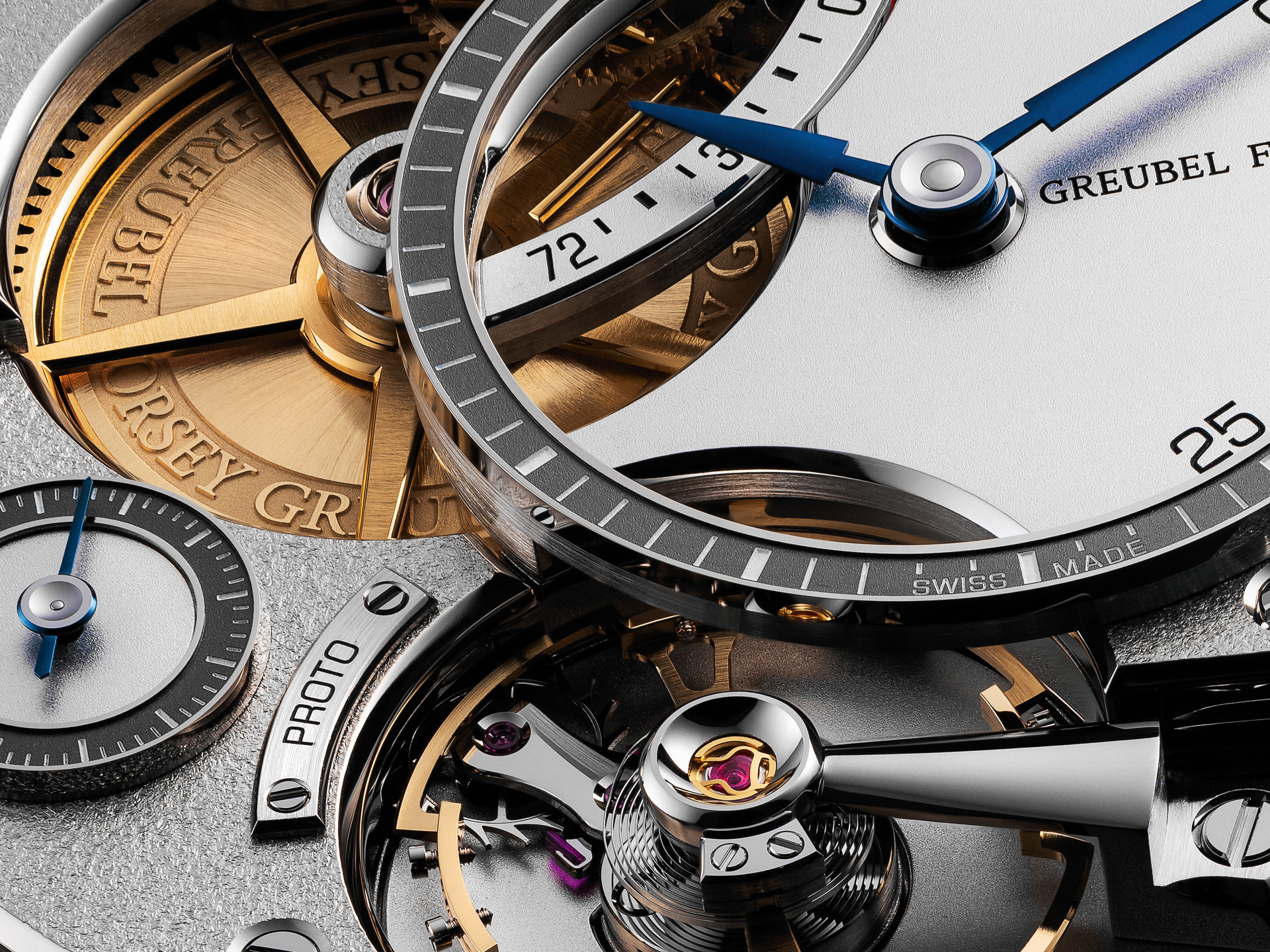
When Robert Greubel and Stephen Forsey founded Greubel Forsey in 2004, hand finishing was a discipline few people looked at closely. They bet everything on it anyway – and set a benchmark that has been the standard of the Atelier ever since: applied to every timepiece, uniformly, and never formally named. The Balancier QM is the timepiece with which we have decided to give that standard a name: Qualité Musée, QM for short.
A turning point
Two things have changed in two decades. The watch world caught up: hand finishing is now one of the most closely-read measures of a timepiece’s quality. And inside our EWT Laboratory we have built a research wing devoted to one thing only: pushing hand finishing further. Balancier QM is the first timepiece to emerge from it. It will not be the last – everything achieved here flows back into the entire collection.
One bridge, seven finishes
There are not two standards of hand finishing at the Atelier: a three-hand timepiece gets the same attention as the Grande Sonnerie. Qualité Musée adds one demand on top – and it is a demanding one: each component, on its own, must hold up as a work of art.
Take the bridge that holds the balance wheel – a few millimetres of steel, where seven hand-finishing techniques converge. The arm is barrel polished, rocked to a flawless mirror over its domed profile. The flat at the jewel end is flat black polished. One surface carries spotting, the recess circular graining. The flanks are hand-polished along the visible contour, straight-grained elsewhere. Every chamfer and bevel is polished by hand – the bevels extra-large at 0.40 mm. Seven operations, one bridge. Now multiply by 298 parts.
The escapement is finished where almost no one bothers to look. The bi-level escape wheel is bevelled and polished on both sides – the hidden face as carefully as the one on view. The pallet-jewels are convex rather than flat, so light travels along the ruby instead of flashing off a single edge. At the heart: an in-house variable-inertia balance, 12.60 mm, with six gold mean-time screws – the regulating organ that gives the timepiece its name. None of this is confined to a single edition: the new escape-wheel geometry and the convex pallet-jewels will be carried progressively across the collection, as will the large bevels and polished flanks wherever they make aesthetic sense.
Made from the wire up
The regulating organ holds one more distinction, invisible to the eye: its hairspring is made entirely in-house, from the raw material up. The pursuit began in 2012, when we set out to produce hairsprings we could not buy – our own alloy, drawn into wire the thickness of a hair through a succession of natural-diamond dies, then rolled flat to a tolerance measured in microns, coiled by hand, and fixed to shape in a precision vacuum furnace. Much of the equipment is antique, reclaimed and restored, because the craft it serves is older than the machines that replaced it. We first realised a complete in-house hairspring for the Hand Made 1 in 2019, and again for the Hand Made 2 in 2025. With Balancier QM, we begin extending fully in-house hairspring production to every Greubel Forsey timepiece. We internalise nothing for its own sake – only where doing so is the surest way to guarantee, component by component, the quality we put our name to.
Designed in depth
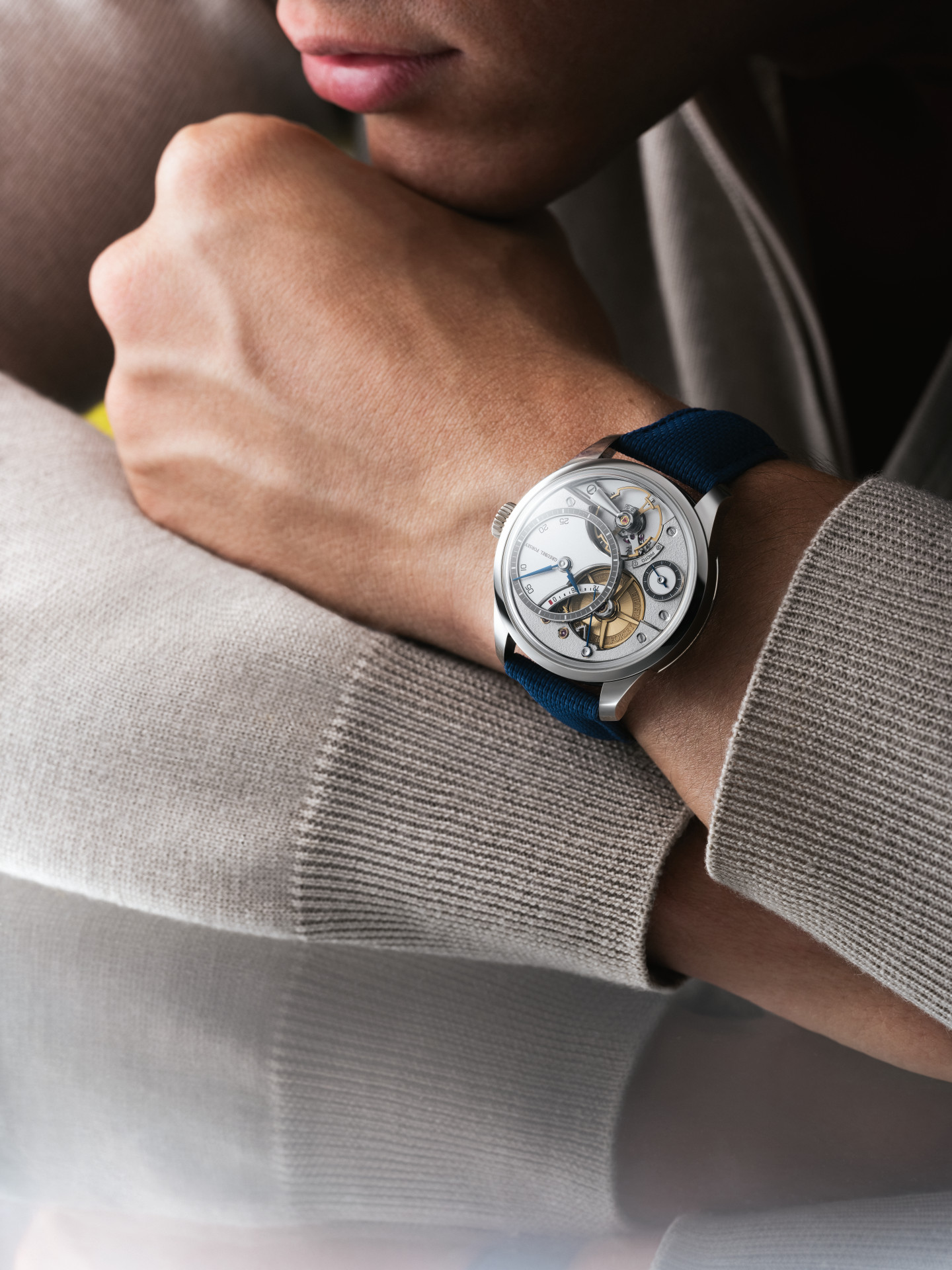
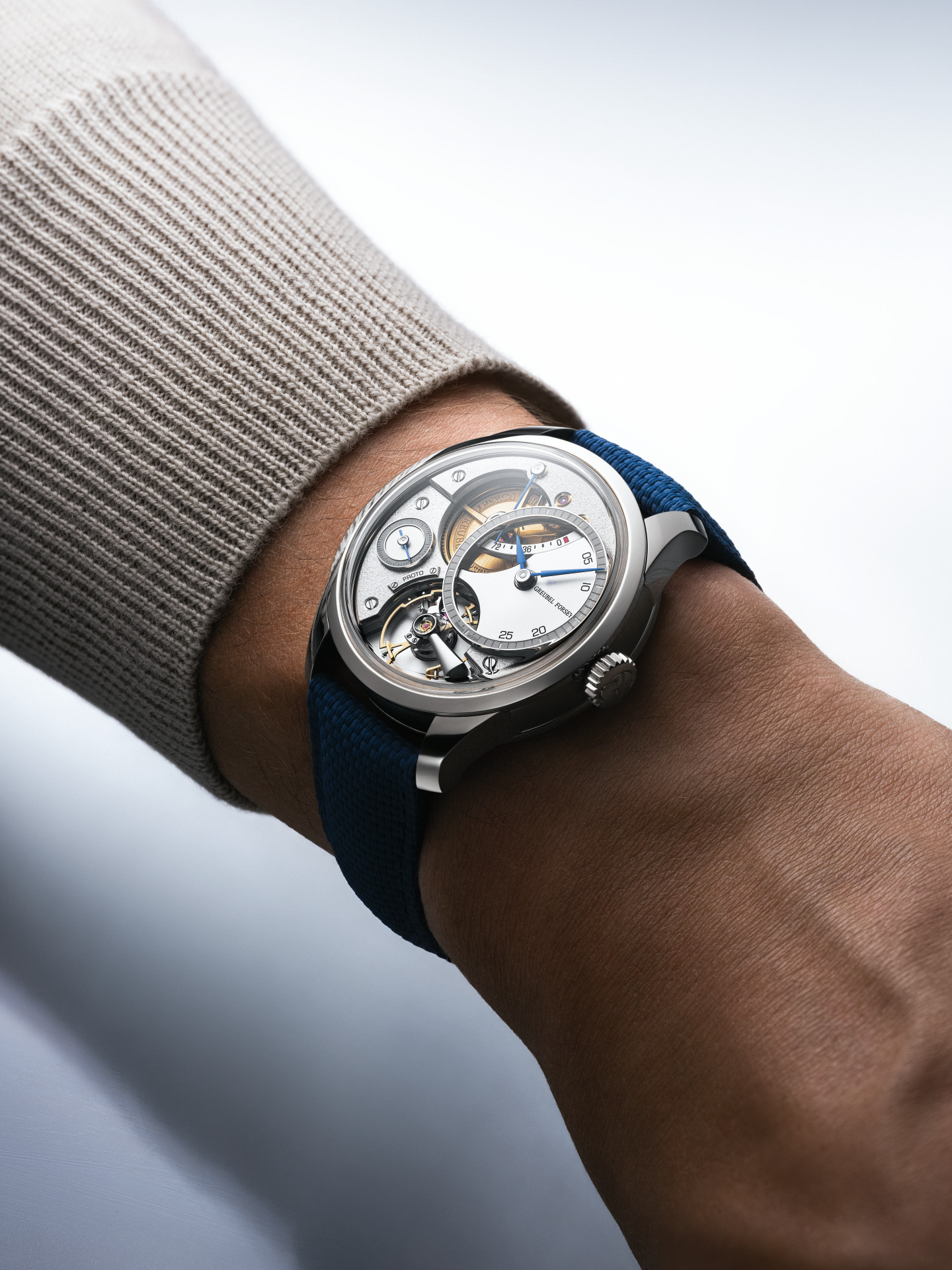
Qualité Musée begins before the first stroke of finishing – it shapes the movement architecture itself. One objective, achieved: to make the timepiece as engaging to look into from the front as from the back, on the wrist and off it. The other is depth. Within a 39.60 mm case, the movement is built as a landscape. The escapement sits deep in the architecture; the eye climbs to the small seconds on a higher plane, descends to discover the mainspring barrel, rises to the flame-blued steel hands, and higher still to the chapter ring – beneath which the power-reserve hand slips mysteriously to display the 72-hour chronometric power reserve on a sector. Two high-domed sapphire crystals give the composition room to breathe. In this, Balancier QM advances an ambition we have pursued for years: to bring fully three-dimensional movement architecture into significantly smaller dimensions.
Visible and invisible
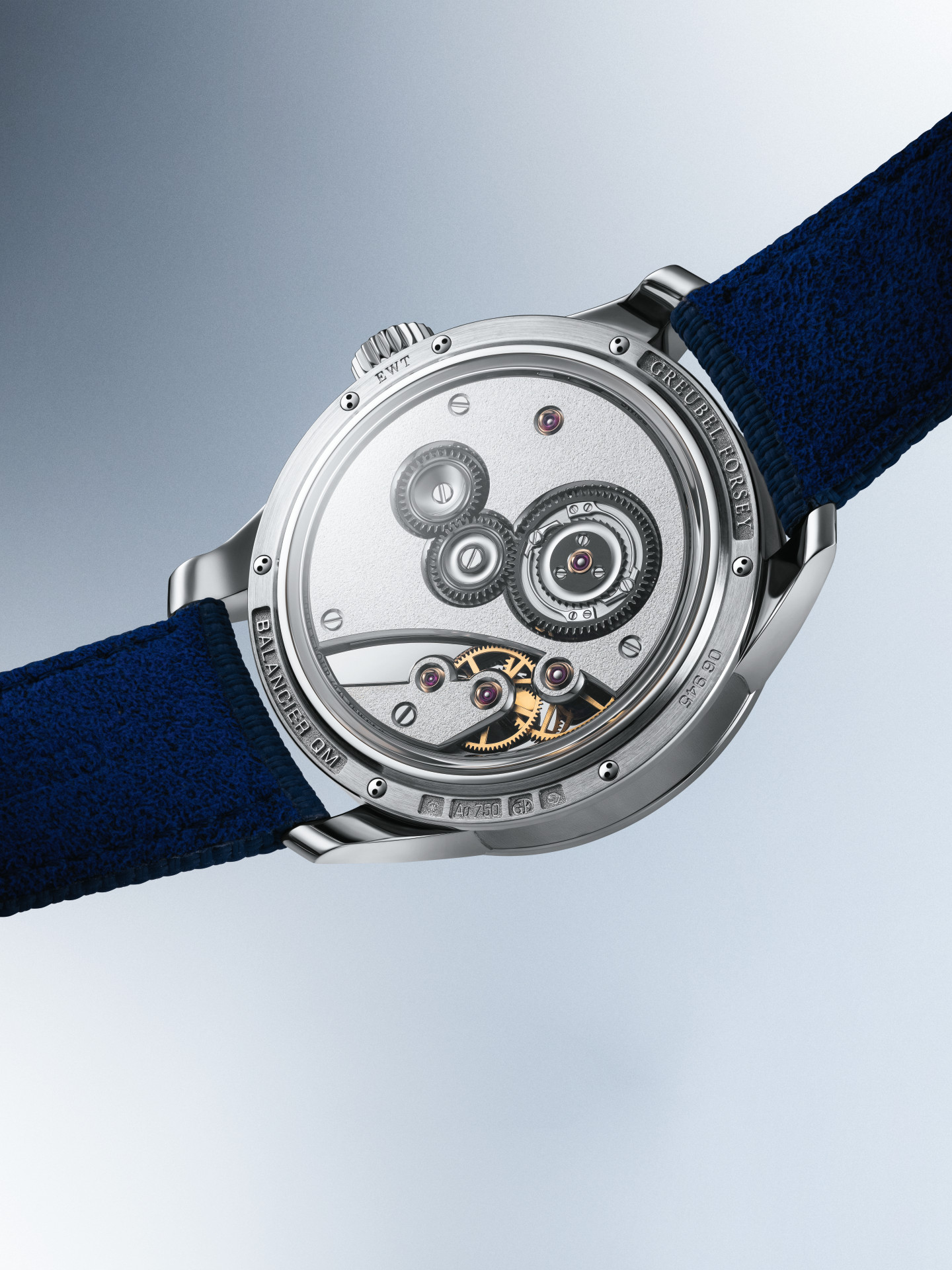
Turn the timepiece over and the caseback puts the winding system itself on stage: wheels with concave hand-polished sinks, bevelled and polished teeth, hand matt lapped; clicks and springs flat black polished, the bevel running unbroken around each part; gold plates flat black polished.
And the standard runs deeper than the surface. As a matter of principle, every component is hand finished to the same standard – the invisible steel parts of the winding mechanism are flat black polished just like the visible ones. To finish only what shows would be to concede that the timepiece is for show. We have decided that it isn’t.
One detail, deliberately discreet: inside the movement sits a secret plate engraved Qualité Musée – the only place the name appears on the timepiece. We did not put it on the dial.
A step further, and a confirmation
Balancier QM is a step further along a road we have travelled since 2004 – and the first of a series pursuing that same ambition in ever more compact form. A new edition of the Nano Foudroyante follows later this year at 37.9 mm; a new movement in a 39.5 mm convex case before the end of 2026; and in 2027, a new invention at 39.5 mm alongside a further movement at 38.5 mm.
It is also a reaffirmation of the values we have always stood for: the pursuit of perfection in execution, in everything we do. That pursuit comes at a cost, and we accept it – work this ambitious may well mean we produce fewer timepieces overall in 2027. We don’t want to measure ourselves by how much we make, but by how well we make it. The aim is to do the best, not the most.
Naming the standard has set us looking further still: Qualité Musée has opened a range of projects within our EWT programme, the next a movement with its entire gear train in gold. Each component a work of art; the whole, an experience built to engage the eye on the wrist and off it. The same logic will carry across the collection. The standard is named.