
A new series of watches born from the collaboration between Vacheron Constantin and the Louvre, inspired by masterpieces exhibited in the museum and paying tribute to the great civilisations of Antiquity
The showcasing of nine decorative crafts through the representation of cultural symbols placed within the decorative arts context of their respective eras
Four models limited to 15 pieces each, powered by the Manufacture Calibre 2460 G4/2, allowing exceptional artistic freedom
Vacheron Constantin and the Louvre Museum, two institutions jointly committed since 2019 to preserving art and culture and passing on traditional craftsmanship
Vacheron Constantin opens a new chapter in its Métiers d’Art Tribute to great civilisations collection of watches. Born from the partnership with the Louvre Museum, the first series of timepieces was unveiled in 2022. Continuing this journey, the Maison now presents four new timepieces that reflect its spirit of cultural exploration. In close collaboration with the museum’s director’s, the Maison selected major works from the Department of Antiquities to celebrate Pharaonic Egypt, the Assyrian Empire, Ancient Greece and Imperial Rome.
As the cradle of modern thought and of the political and social organisations that shape today’s world, the civilisations of Antiquity continue to fascinate through their artistic and architectural achievements. This attraction to foreign and ancient cultures has long nurtured Vacheron Constantin’s spirit of exploration and creativity. The Maison’s commercial expansion from the early 19th century into the Americas, the Middle East and Asia provided countless sources of artistic and cultural inspiration.
Four new Métiers d’Art Tribute to great civilisations pieces celebrate the Louvre Museum’s ancient masterpieces and the decorative arts associated with them, with a constant concern for historical accuracy and authenticity. In agreement with the heads of the Louvre’s departments, the reproduction work took into account the materials used for the original works, namely stones of the same origin and quality. The decorative crafts highlighted in these pieces reflect Vacheron Constantin’s ongoing commitment to preserving and showcasing traditional skills such as glyptics, micro-mosaic, engraving, enamelling, marquetry, gilding and miniature painting.

ARTISTICALLY DESIGNED DIALS
The complexity of the decorative crafts used on these watches required a dial construction composed of several elements, each corresponding to a specific technique. Positioned on a gold base plate, the centre features the effigy of a work representing one of the four civilisations, along with applique ornamentation reflecting the decorative arts characteristic of each culture. Around the periphery, a frieze completes the composition. In order to be assembled like a puzzle, these various components must be perfectly calibrated and adjusted with meticulous care so as not to alter the respective work of each artisan involved in the dial’s ornamentation.
The central effigy is created using stone glyptics, a stone-carving technique consisting of engraving or sculpting the material in relief, traditionally used in the creation of cameos. The selection of stones — identical in nature and/ or origin to those used in the Louvre works — required extensive research. The appliques accompanying the four central figures, as well as the peripheral friezes, both inspired by pieces exhibited in the museum, were also the subject of in-depth study with Louvre experts in order to respect the traditional ornamentation of the four civilisations.

CALIBRE 2460 G4/2 TECHNIQUE IN THE SERVICE OF ART
Leaving the dial free of any hands, the Calibre 2460 G4/2 offers a vast space of expression for master artisans. This 237-component self-winding Manufacture movement is distinguished by its peripheral display of the hours, minutes, day, and date. These indications appear on discs visible through four apertures positioned at the upper and lower sections of the dial. The colours of the discs harmonise with the dial décor and therefore vary according to their placement. Beating at a frequency of 4 Hz (28,800 vibrations per hour) and equipped with a 40-hour power reserve thanks to bidirectional winding, the movement has a thickness of just 6.05 mm.
On the reverse side of the movement, the oscillating weight pays tribute to the Louvre through an 18th-century engraving depicting the museum’s East façade and its colonnade inspired by the work of Louis Le Vau and Claude Perrault. The design matrix was hand-carved before being used to stamp the oscillating weight. The same attention to detail can be found in the movement’s haute horlogerie finishes, which meet the requirements of the Hallmark of Geneva Seal. Visible through the sapphire caseback are bevelled bridges adorned with Côtes de Genève, a circular-grained mainplate and circled wheels.

DECORATIVE CRAFTS IN THE SPOTLIGHT
• Glyptics and sculpture
Glyptics consists of engraving hard materials such as stone, crystal or gemstones to create designs either carved in intaglio or in relief. It requires extreme precision of gesture and a thorough understanding of the material, whose layers, inclusions, and hardness influence every incision. In watchmaking, glyptics is applied to miniature decorative elements only a few millimetres thick, hand-carved under a binocular microscope. Sculpture, which is closely related, involves a more volumetric approach in which the artisan works with depth, textures and light to bring a figure, scene or symbolic motif to life.
• Micro-mosaic
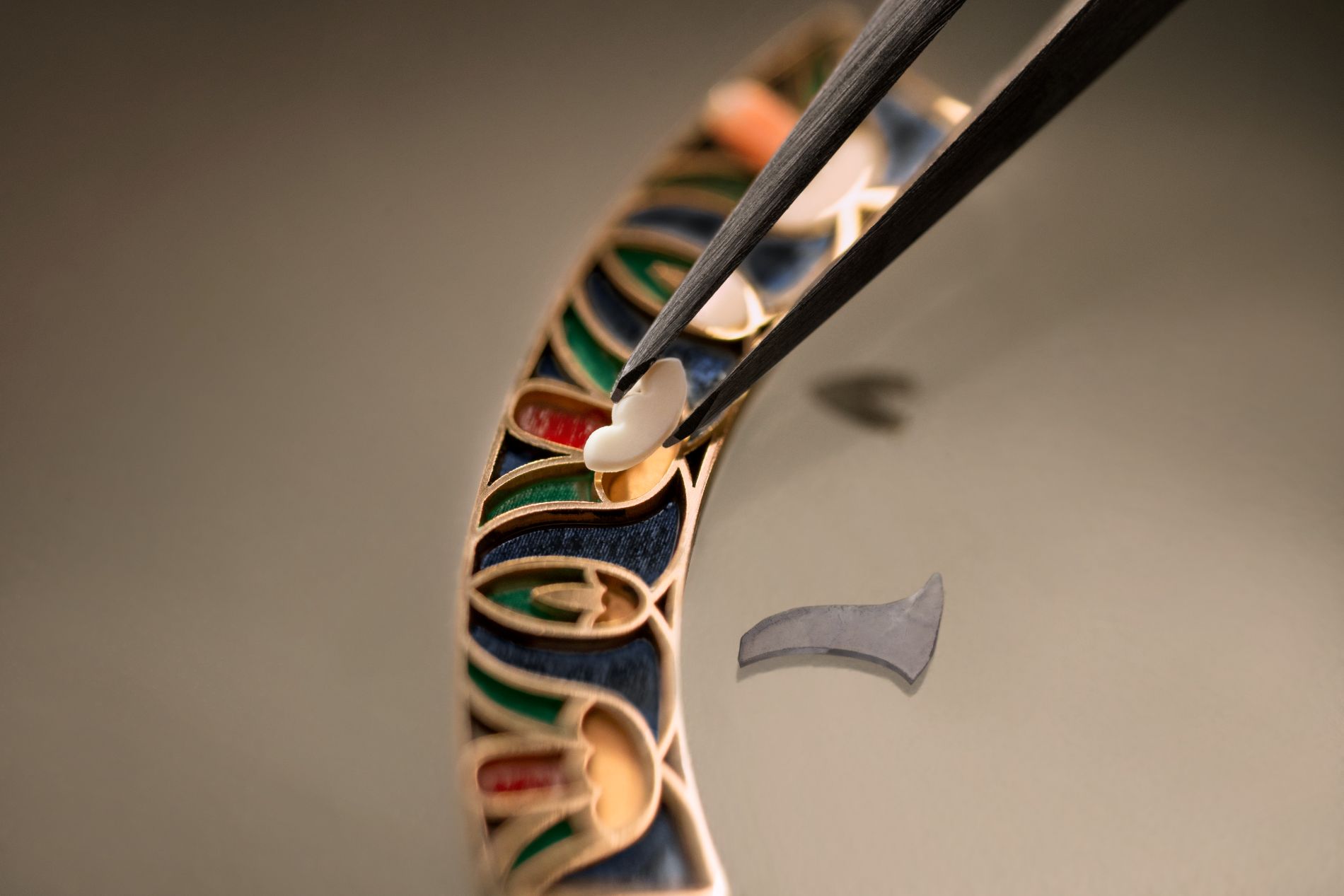
Micro-mosaic is an art consisting of assembling tiny tesserae, generally made of glass paste, enamel or stone, whose size can be smaller than a millimetre. Each fragment is selected for its colour and shape and then positioned under a binocular microscope according to the desired pattern. The result forms an image akin to a mineral painting of striking figurative beauty.
• Marquetry and cloisonné marquetry
Marquetry involves composing a motif or scene by assembling thin “leaves” or veneers made from a variety of materials: rare woods, mother-of-pearl, straw, precious metals, soft stones or even leather. Each element is cut and adjusted with extreme precision before being fixed onto a base and sometimes shaded, engraved, or enhanced with miniature painting to provide additional detail. Cloisonné marquetry, for its part, is a unique process combining metalwork and veneer work in reference to the technique of cloisonné enamelling. The marquetry components are inserted within fine gold wires forming the framework of the design to be created. The same technique may also be applied in a champlevé manner by hollowing out the material.
• Enamelling and miniature painting
Enamelling is an art of fire: coloured glass powders are applied to a gold surface and then fired at high temperatures to create a glossy and durable vitrified layer. Several techniques are used on these pieces — champlevé enamel, flinqué enamel and miniature enamel painting — yet all require mastery of the materials’ coefficients of expansion as well as perfect preparation of the pigments. Champlevé enamel consists of engraving cavities into the thickness of the metal into which enamel powder is deposited in successive layers, each fired in the kiln. Flinqué enamel involves covering an engraved or guilloché plate with translucent enamel in order to give it greater consistency and depth. Miniature enamel painting, meanwhile, much like a master painter’s canvas, involves hand-painting motifs and ornamentation on a surface specially prepared for firing.
• Engraving
Engraving on a watch dial consists of directly incising the metal surface — gold, mother-of-pearl or hard stone — using burins or micro mills to create a continuous, regular and perfectly symmetrical motif. Performed under a binocular microscope, the work requires exceptional mastery of gesture to ensure consistent depth, sharp edges and uniform relief across a surface only a few millimetres thick. Depending on the desired aesthetic, the artisan may play with different textures — satin-finishing, graining or polishing — to enhance contrasts and capture the light.
• Gilding
On a watch dial, gold leaf gilding is a particularly delicate technique. It consists of applying extremely thin leaves of pure gold to the surface of the dial, giving it the radiance and appearance of solid gold. This meticulous process produces a luminous surface of great refinement, capable of offering a variety of finishes, whether brilliant or matte. The technique enriches the dial with a precious and lasting touch.

BUSTE D’AKHÉNATON
EGYPTIAN NEW KINGDOM (1500–1000 BC)
The colossal statue of Akhenaten exhibited at the Louvre bears witness to a singular moment in Egyptian history: the political, religious and artistic reform led by this unconventional pharaoh, whose reign lasted from 1355 to 1337 BC. Son of Amenhotep III, Akhenaten sought to impose the cult of Aten (the solar orb) and to centre it around the king and his family as the sole intermediaries between the human and divine realms. This reform ultimately proved unsuccessful: Tutankhamun, Akhenaten’s son, and successor, swiftly restored the traditional cults. Yet brief as this so-called “Amarna period” of ancient Egypt may have been, it remains one of the most fascinating episodes in its history, notably marked by new aesthetic canons that are clearly visible in the bust of Akhenaten.
Discovered in the 19th century at Amarna, the bust of Akhenaten preserved in the Louvre Museum is fragmentary. Originally, it formed part of a group of pillars erected during the early years of the pharaoh’s reign in a building constructed east of the temple of Karnak. The sovereign is depicted wearing a long ceremonial false beard and holding the two royal sceptres, of which only the handles remain. Carved in sandstone, the statue of the pharaoh is striking for its elongated, almost abstract face, with stretched eyes, full lips, and a pointed chin. This apparent androgyny reflects the religious and artistic revolution initiated by Akhenaten.
To represent him at the centre of the dial, Vacheron Constantin’s designer chose a slightly low-angle profile view, lending the figure an enigmatic expression. The portrait is executed in glyptics. In the interestof authenticity, this reproduction is carved from limestone sandstone from the Sinai in Egypt — the same stone used for the original work. It is hand-patinated to enhance realism, giving it greater volume and depth. Facing it, the pharaoh’s cartouche is engraved on the same calcareous sandstone, based on a wall relief from Karnak. These two central dial components required around 60 hours of work.
Two friezes frame the pharaoh. The outer frieze, inspired by the collar of Nakhti — a jewel composed of tubular beads attributed to this Egyptian chancellor of the 12th Dynasty — is drypoint engraved on a single turquoise ring. A gold border separates it from the inner frieze, executed in stone champlevé, in which the elements are inserted into a motif formed by finely engraved gold threads. For this composition — assembling tiny tesserae of red mother-of-pearl, chrysoprase, opaline and sodalite — the inspiration was drawn from a 7th-century BC pectoral preserved in the Department of Egyptian Antiquities at the Louvre. The creation of these two friezes required approximately 150 hours of work.

LAMASSU DE SARGON II
NEO-ASSYRIAN EMPIRE (934–609 BC)
Monumental in scale, the winged human-headed figures from the palace of Khorsabad rank among the most impressive treasures in the Louvre’s Department of Near Eastern Antiquities. These five-metre-high Lamassus
— part bull, part eagle, part man — once guarded the gates of the palace and city of Sargon II, king of Assyria, in what is now northern Iraq. Through numerous conquests, Assyria became a vast empire during the first millennium BC, extending from its Mesopotamian heartland to Egypt, Anatolia, and Persia. Its rulers commissioned grand palaces, such as Dur-Sharrukin — present-day Khorsabad — built by Sargon II, whose reign lasted from 721 to 705 BC. Everything was designed to evoke grandeur, including these Lamassus, the protective guardians of the city.
Carved from enormous blocks of alabaster, these sculptures combine high relief for the body with sculpture in the round for the head. With their braided beards, outstretched wings and five sculpted legs designed to create the illusion of movement depending on the viewing angle, the Lamassus were originally painted, like all the reliefs decorating Assyrian palaces. Identified during pioneering excavations conducted by the French archaeologist Paul-Émile Botta from 1843 onwards, the remains of Sargon II’s palace marked the beginning of the archaeological rediscovery of the Assyrians, previously known mainly through the Bible and other ancient texts. Some of these remains are displayed at the Louvre; others remain on site or can be seen in the museums of Baghdad and Mosul in Iraq. Today, the “Khorsabad Court” at the Louvre evokes the palace environment with original works and two plaster casts.
The gold base of the dial features stone champlevé work — a technique inspired by enamelling in which tiny tesserae are inserted into a framework engraved directly into the material. This highly figurative composition, combining slender rods of red agate and blue dumortierite, draws its inspiration from a mural painting of a winged human-headed bull discovered at Til Barsip (Syria) dating from the 8th century BC and reproduced on a scroll preserved at the Louvre.
This base is also engraved and enhanced with flinqué enamel to create a sense of depth. The technique consists of engraving the material according to the desired motif — here the feathers of the Lamassu — before applying several layers of translucent enamel, in this case tinted red. Once the decorative setting has been established — after 145 hours of work — the applique of the Lamassu exhibited at the Louvre is added. It is executed in glyptics from limestone sandstone originating from Italy, a stone slightly harder than gypsum. To accentuate the features of the androcephalous creature, the engraver completes the work with a hand-applied patina. The outer frieze is made of engraved gold, based on a motif depicted in an 1863 painting held at the Louvre showing The Visit of the Pasha of Mosul to the Digs of Khorsabad.

ATHÉNA DE VELLETRI
ANCIENT GREECE (480–323 BC)
The majestic Pallas of Velletri preserved at the Louvre embodies the power and martial wisdom of the patron goddess of Athens. Discovered in 1797 near Velletri, south of Rome, this marble statue standing over three meters high is a Roman copy of a Greek original sculpted around 430 BC by Cresilas, a contemporary of Phidias who is also credited with a celebrated portrait of Pericles. Athens conceived this Pallas only a few decades after its victory over the vast Persian Empire during the Greco-Persian Wars. The rising power of Athens had just established its hegemony over a large part of the Greek world, notably thanks to the strength and efficiency of its fleet. This period marks the “Golden Age of Athens”, when the city-state experienced an unprecedented era of prosperity and influence on intellectual, political, and artistic levels.
The Pallas statue in the Louvre, depicted wearing a helmet and draped in a peplos, experienced a particularly eventful history. After passing through the hands of the renowned Roman sculptor and restorer Vincenzo Pacetti (1746–1820), it was purchased by France during the Directoire and exhibited at the Villa Medici, before being seized by the troops of Ferdinand IV of Naples during the capture of Rome in 1798. It was Napoleon who, fascinated by the symbolism of this warrior goddess of wisdom, negotiated its acquisition in 1801 during the peace treaty signed in Florence between France and the defeated Kingdom of Naples. Two years later, the statue entered the collections of the Louvre.
The majesty of the Pallas of Velletri is conveyed through glyptic work executed in marble from Paros, a Greek island in the northern Aegean Sea. This is the same stone as that used for the original statue, renowned for its dazzling whiteness and large-crystal composition. On the dial, the goddess of Athens is depicted in three-quarter view from a slightly low angle, giving her a commanding posture over the world. Hand-patinated to accentuate shadows and relief, the applique is mounted on a gold dial previously entrusted to the enameller. The latter created a black champlevé enamel frieze on the yellow-gold base with lace-like precision. A krater preserved at the Louvre, painted by Aegisthus around 460 BC and depicting the murder of Tityos, provided inspiration for this frieze, which is itself framed by a second one in engraved and patinated white gold inspired by a Dionysian scene.
The centre of the dial is decorated with a stone marquetry composition inspired by a Greek amphora from Milo dating from the late 5th century BC. The original depicts the battle between giants and gods fighting from chariots drawn by horses. These same horses appear in the central marquetry of this piece, executed in onyx and creamy white and orange mookaite. Faithful to the original, it captures the vigour and expressiveness of the horses through miniature painting applied to the stones marquetry. Around 60 hours of work were required to create this part of the dial.

TIBRE DE L’ISEUM CAMPENSE
IMPERIAL ROME (27 BC – 476 AD)
Discovered in Rome in 1512 on the site of a sanctuary dedicated to the Egyptian gods Isis and Serapis, the imposing marble sculpture of the god Tiber, measuring 1.76 metres in height, depicts the aged, bearded river god reclining on a stone bed and holding a cornucopia overflowing with fruits and ears of grain. At his side, the she-wolf nurses Romulus and Remus, recalling the founding myth of Rome. Monumental and allegorical, the statue of the Tiber celebrates the narrative of the city’s origins. The Tiber was indeed a vital artery without which the Eternal City, located in its lower valley, would never have experienced such growth. During the time of the Empire founded by Augustus in 27 BC, Rome had a population of around one million inhabitants — a figure that cities such as London or Paris would only equal at the beginning of the 19th century.
The statue of the Tiber is among the many works seized by Napoleon Bonaparte in Italy following the Treaty of Tolentino in 1797 and transported to the Louvre for display. After the fall of the Empire in 1815, some of the works taken from Italy and Germany were returned, but the statue of the Tiber — presented by Pope Pius VII to the new king Louis XVIII — remained in France.
At the centre of the dial, shown in three-quarter view, the head of the Tiber and his cornucopia are executed in glyptics on marble. The stone used for this applique originates from Italy, as is the case with the original statue. Sculpted and patinated to highlight every detail, this depiction of the river god is highly realistic, conveying the impression of tranquil power expressed by the sculpture. Facing it is a second applique executed in stone micro-mosaic, inspired by a mosaic dating from the late 2nd century AD discovered in Utica (Henchir Bou Chateur in Tunisia), also preserved at the Louvre. Its floral decoration is reproduced using thousands of fragments of jasper, chrysocolla and opaline. The interstices between the stones, serving as joints within the composition, are finished with miniature painting in several colours matching the stones.
The gold base dial supports these two appliques. Textured with gold leaf, giving it a subtly grained appearance, it is then covered with translucent enamel. An engraved mother-of-pearl frieze executed in drypoint surrounds the composition. It is inspired by a Campana plaque — a terracotta relief from the Louvre dating from the 1st century BC — depicting a Dionysian dance scene. The creation of this dial requires collaborative work between the engraver, enameller and micro-mosaic artisan.

AN ARTISTIC AND CULTURAL PARTNERSHIP
Vacheron Constantin and the Louvre formalised their artistic and cultural partnership in 2019. United by the same vocation of conserving, preserving and transmitting the arts and artisanal knowledge, the two institutions collaborate on various projects. One of the first outcomes of this alliance took shape during the “Bid for the Louvre” auction held in 2020 to raise funds supporting the museum’s cultural solidarity initiatives. For the occasion, Vacheron Constantin imagined a distinctive experience: the highest bidder could select a work of art from the Louvre to be reproduced by the Maison’s master artisans on the dial of a bespoke watch. This is how the piece Les Cabinotiers – Tribute to Peter Paul Rubens, The Fight for the Standard of the Battle of Anghiari was created in 2023.
The Métiers d’Art Tribute to great civilisations series of watches presented in 2022 brought together the Maison and the museum in celebrating the splendours of the past and the means of perpetuating them. More recently, as part of its 270th anniversary in 2025, Vacheron Constantin chose the Louvre to unveil and exhibit La Quête du Temps, an astronomical automaton clock comprising 2,370 components and 22 complications. It was displayed within the museum alongside other works, including La Création du Monde, an 18th-century masterpiece of precision clockmaking whose restoration was supported by Vacheron Constantin in 2016.