
Innovation in watchmaking crafts: a programme fostering the future of horological craftsmanship through incubation and new approaches Miniature mastery: achieving dial depth with unexpected crafts deployed on six concept watches A celebration of nature: fauna as the inspiring muse and unifying thread of the timepieces Vacheron Constantin presents Métiers d’Art Tribute to the Animal Kingdom, a series of six concept watches created within the Maison’s “One of Not Many Crafts Programme,” dedicated to fostering the future of horological craftsmanship.
The project invites six artisans whose practice lives outside the traditional métiers d’art associated with horology and challenges them to transpose their craft onto the scale
of a watch dial.
Each creation proposes a distinct artistic interpretation of wildlife, expressed through a different craft and brought to life on the dial — made possible by the Calibre 2460 G4 and its peripheral indications of time and date that turn the surface of the dial into a canvas for creative expression.
INNOVATION IN WATCHMAKING CRAFTS:
FOSTERING THE FUTURE OF HOROLOGICAL CRAFTSMANSHIP THROUGH INCUBATION AND NOVEL APPROACHES
The preservation and perpetuation of creative endeavors has always been at the heart of Vacheron Constantin’s identity since its founding in 1755. This longstanding commitment has led the Maison to integrate workshops dedicated to Métiers d’Art such as guillochage, engraving, enameling, gem-setting and high watchmaking — traditional decorative arts in horology that have been passed down from generation to generation.
Always looking towards the future, the Maison has also developed partnerships with cultural institutions including the Louvre and The Metropolitan Museum of Art, while supporting artists and artisans through initiatives dedicated not only to safeguarding their activity, but also to promoting education, public appreciation and understanding of the arts.
Through its “One of Not Many Crafts Programme,”
Vacheron Constantin continues this commitment by encouraging innovation in the crafts applied to watchmaking.
The initiative invites artisans whose practice lives outside the traditional métiers d’art associated with horology and challenges them to transpose their craft onto the miniature scale of a watch dial while respecting the technical constraints of a fully functional timepiece.
“Vacheron Constantin’s mission is to build and innovate, constantly pushing the boundaries of Haute Horlogerie.
This is achieved by pioneering unique techniques and demonstrating unparalleled technical prowess, often integrating crafts previously unseen in watchmaking.
The Maison ensures the vital transmission of centuriesold savoir-faire, while continuously exploring and mastering diverse new fields», comments Sandrine Donguy Product & Creation Director.
This programme exemplifies Vacheron Constantin’s ongoing commitment to fostering artistic excellence and preserving invaluable savoir-faire. By extending its support beyond traditional horological métiers d’art, the Maison actively contributes to the broader ecosystem of artistic creation. This approach not only encourages the exploration of new creative avenues within watchmaking but also reinforces the importance of human skill and artistic expression across various disciplines, ensuring their relevance and evolution for generations to come.
“By inviting practices rarely associated with horology onto the watch dial, the “One of not Many Crafts Programme” expands the creative vocabulary of Métiers d’Art within watchmaking. This approach has encouraged thinking beyond established categories —a form of creative incubation that opens new possibilities for artistic expression within the constraints of watchmaking”, explains Christian Selmoni, Maison Legacy and Style Director.
The finished timepieces have emerged from the dialogue between the independent artisans and the Maison’s own specialists, requiring both to confront unfamiliar technical and creative challenges. Through this exchange, new tools, techniques and working methods emerge, enriching the savoir-faire of both the invited artists and Vacheron Constantin’s own Métiers d’Art masters.
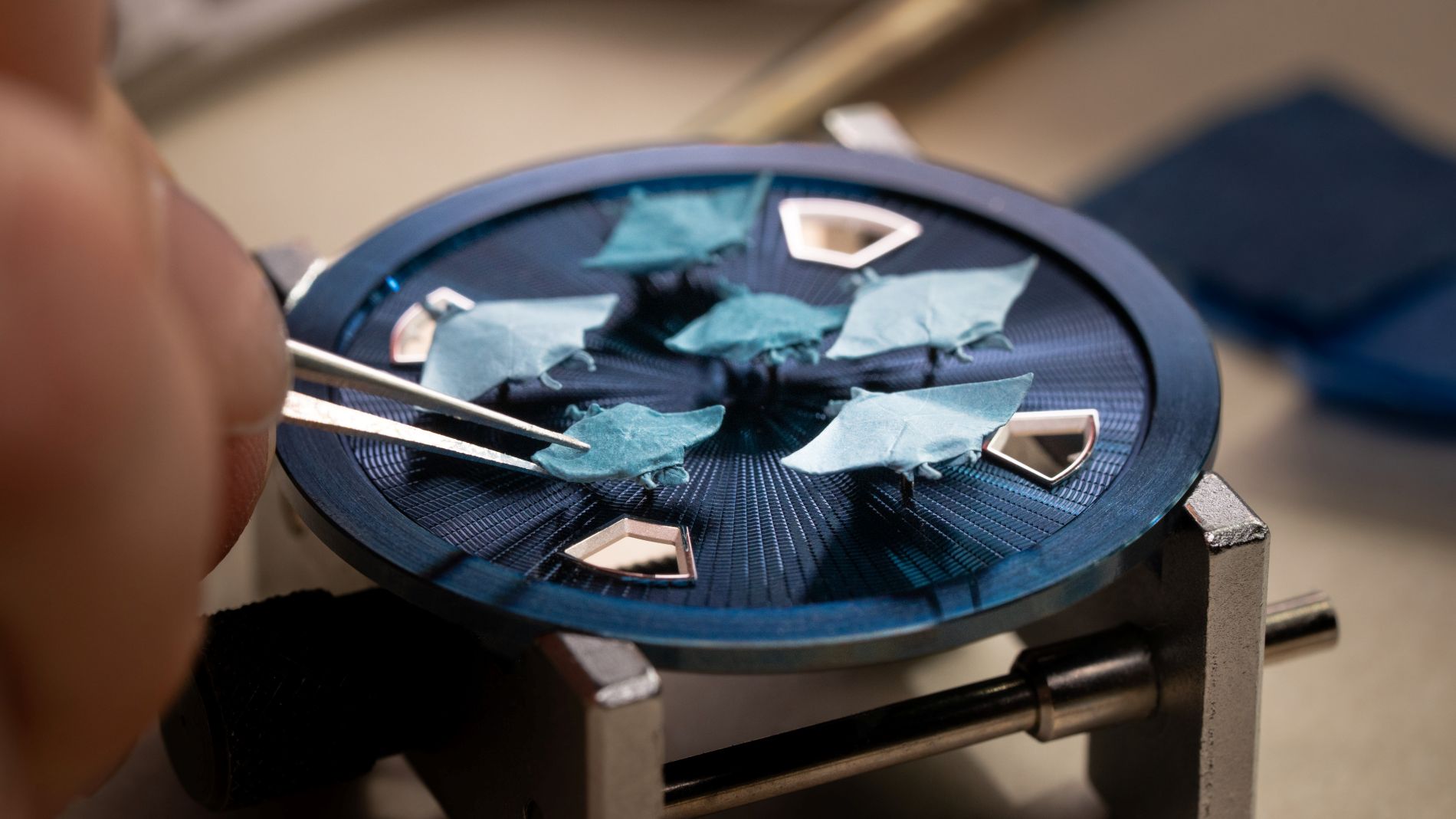
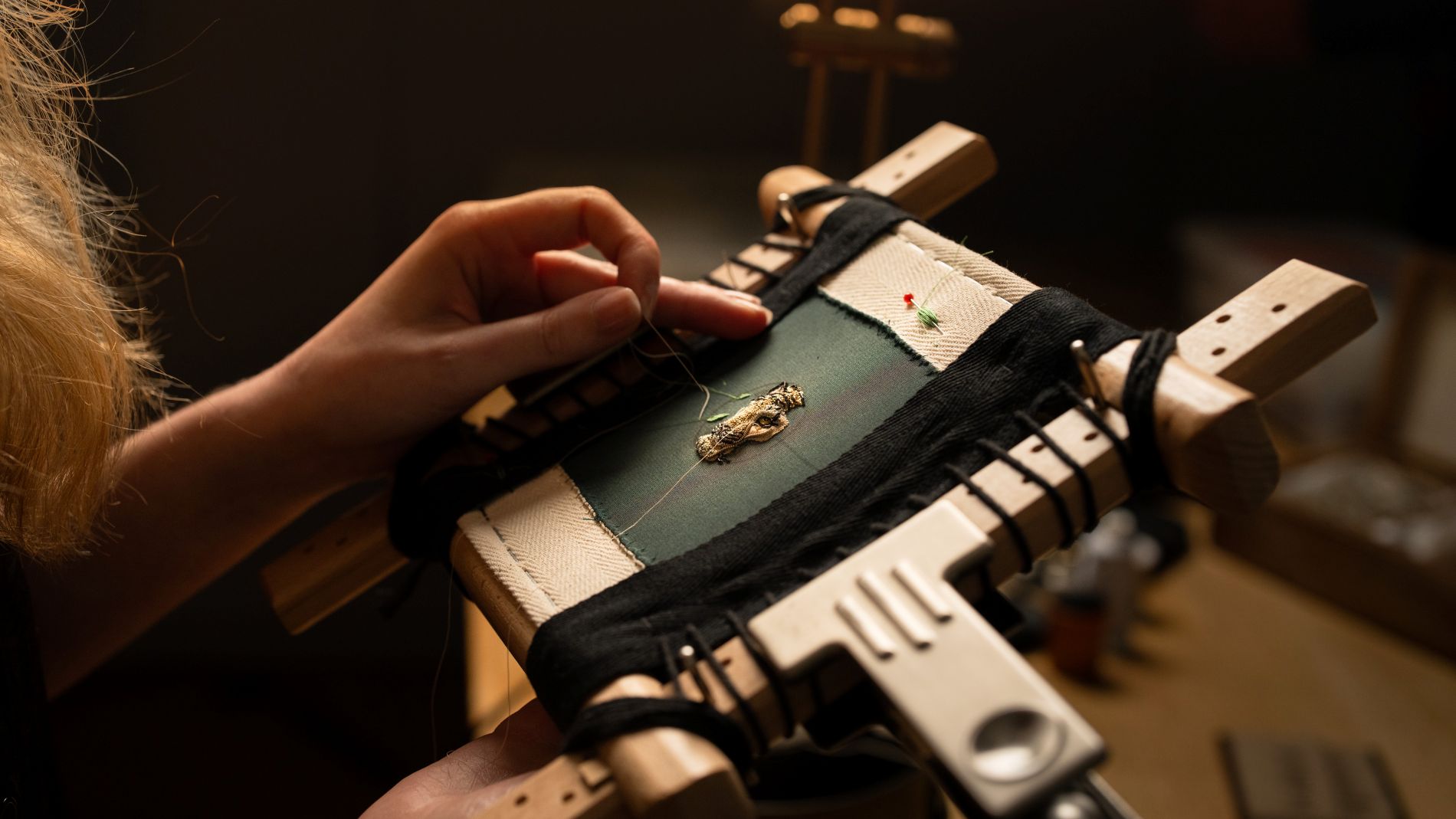
The result is a series of six concept watches, each rooted in a distinct craft and each expressing a singular artistic language. Gold embroidery, feather work, wood marquetry, glass sculpting, paper sculpting, and micro-origami: six disciplines, six artists, six dials that function as miniature works of art, all inspired by the animal kingdom, a cherished, longstanding source of inspiration for Vacheron Constantin.
Showcasing exceptional craftsmanship and artistic vision, every creation is a work of art in its own right and Vacheron Constantin’s watchmakers have also adapted the features and finishes of the Calibre 2460 G4 to integrate seamlessly with each piece’s overall aesthetic achieving harmony between art and haute horlogerie. Distinguished by its unconventional display system in which the hours, minutes, day of the week and date indicated through four apertures at the four extremities of the dial, the calibre leaves the dial entirely free for artistic expression, allowing the métiers d’art creation to take center stage.
The collection is further united by two signature elements.
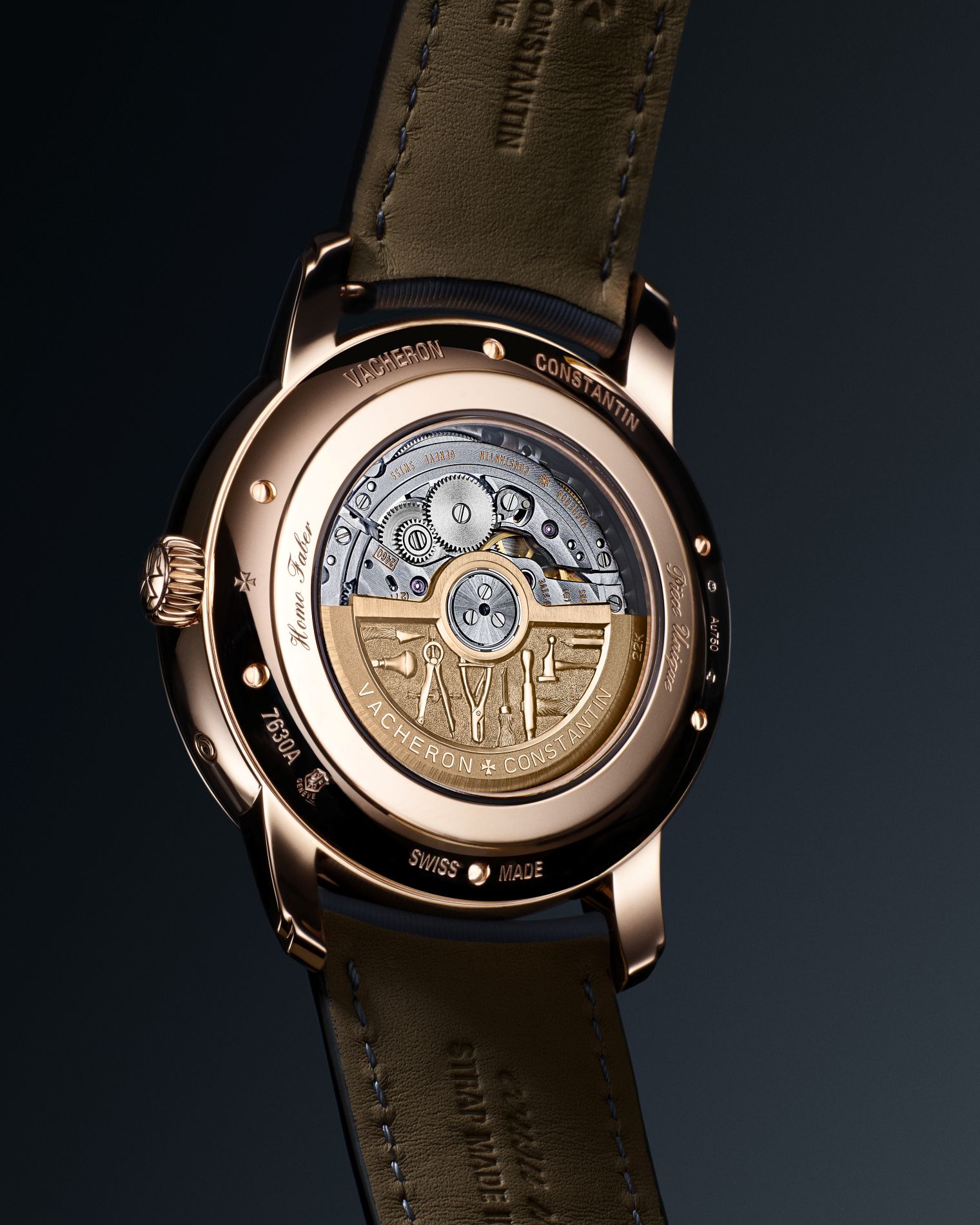
A 22K gold oscillating weight, specially designed and hand-engraved for the series, with motifs inspired by the tools of artisans as a tribute to craftsmanship. Each watch is also paired with a dedicated strap, embossed with motifs echoing the visual language of the dial.
MINIATURE MASTERY:
ACHIEVING DIAL DEPTH WITH UNEXPECTED CRAFTS DEPLOYED ON SIX CONCEPT WATCHES
Bringing together six artists who had never previously worked at such scale with this volume, the project transforms the timepiece into a laboratory of artistic experimentation.
Within the strict dimensions of a 42-millimeter case, offering no more than 4 millimeters of height between the dial’s surface and the sapphire crystal protecting it, each artisan was compelled to rethink their craft entirely, adapting techniques traditionally associated with larger-scale works to the microscopic universe of haute horlogerie.
Featherwork, glass sculpting, paper sculpting, gold embroidery, wood marquetry and micro-origami were pushed beyond their conventional limits through years of research, prototyping, and the invention of entirely new tools and processes.
The project fostered a mutually enriching dialogue between artists and Vacheron Constantin’s watchmakers and craftsmen, whose expertise in mastering miniaturization proved essential in resolving technical challenges and integrating these crafts into the delicate architecture of a perfectly functioning watch.
The result is a series of timepieces in which traditional crafts, reinterpreted at miniature scale, are transposed onto the dial, expanding the creative vocabulary of Métiers d’Art within horology while offering an avantgarde reinterpretation of the animal world — the inspiring muse chosen for the project and the unifying thread connecting all six timepieces.
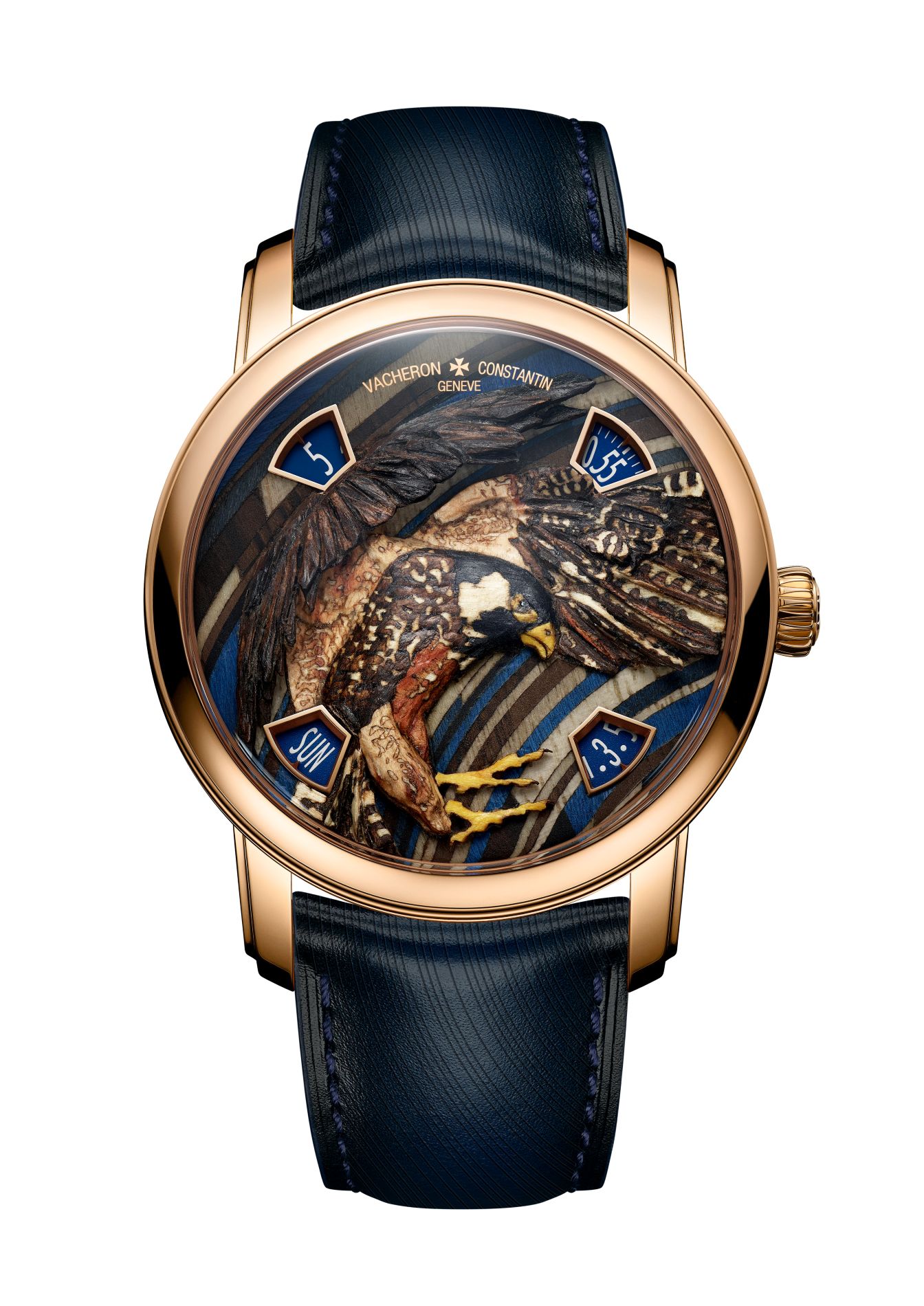
FEATHERWORK
Métiers d’Art Tribute to the Animal Kingdom – Feathersnake
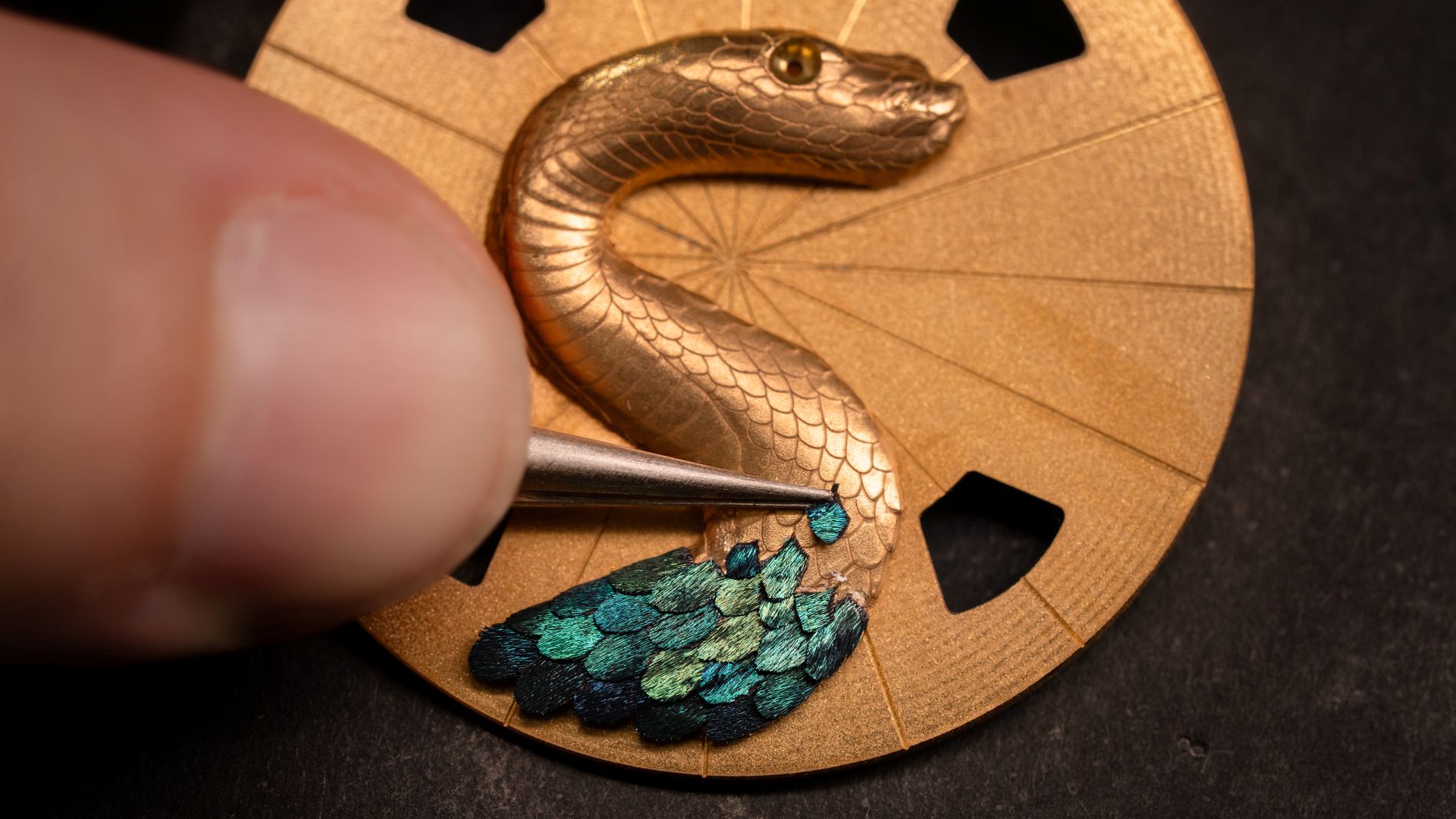
Featherwork was chosen to bring to life an imaginary serpent coiling across the dial within a fantastical landscape. Rising only three millimeters above the surface, the snake achieves its remarkable sense of volume and plasticity. This intricate three-dimensional effect is made possible by a specially developed metal applique, which serves as a support for the feathers, allowing the artist to maximize their volume. The natural iridescence of the plumes, with their shifting reflections, further enhances the illusion of depth. To achieve this effect, the snake itself is a masterpiece of micro-plumasserie, meticulously crafted from over 200 tiny pieces derived from seven rare Lophophore feathers. These delicate pieces were applied onto silk paper to allow for an exceptionally precise cut, forming a snake shimmering with blue-green tones evocative of living scales. The surrounding foliage and background are executed in goose feathers.
To craft this feather tableau, the artisan, excelling in the art of micro-plumasserie, first removed the feather’s central quill, which would have otherwise created excessive thickness, while preserving the delicate structure of the barbs. The feathers were then mounted onto silk paper, enabling precise cuts before being applied on the metal snake applique and then the dial to perfectly fit the peripheral apertures through which the indications of time and date are displayed.
Existing instruments proved inadequate for the extreme miniaturization of the work, leading the artisan to create a custom micro-scalpel from a reshaped needle, as well as a modified sewing needle refined further to apply microscopic dots of glue.
Completed over approximately 250 hours, including research and prototyping, the work demanded a level of precision comparable to surgery.
The snake’s eye, a single point of stillness within an otherwise kinetic composition, is crafted in 18-karat gold and enamel, anchoring the piece and subtly reminding the viewer that beneath this display of artistry lies a functioning timepiece.
Extending the vegetal landscape beyond the dial itself, the calfskin strap is embossed with a leaf motif echoing the foliage of the composition and secured by an 18-karat white-gold buckle.
Kingdom – Glassoctopus
From the nocturnal circular landscape of the dial, a miniature transparent octopus appears to drift as if suspended in an imaginary underwater world. The background is composed of a hand-guilloché gold base coated with a dark blue color that invites the spectator into the depths of the ocean.
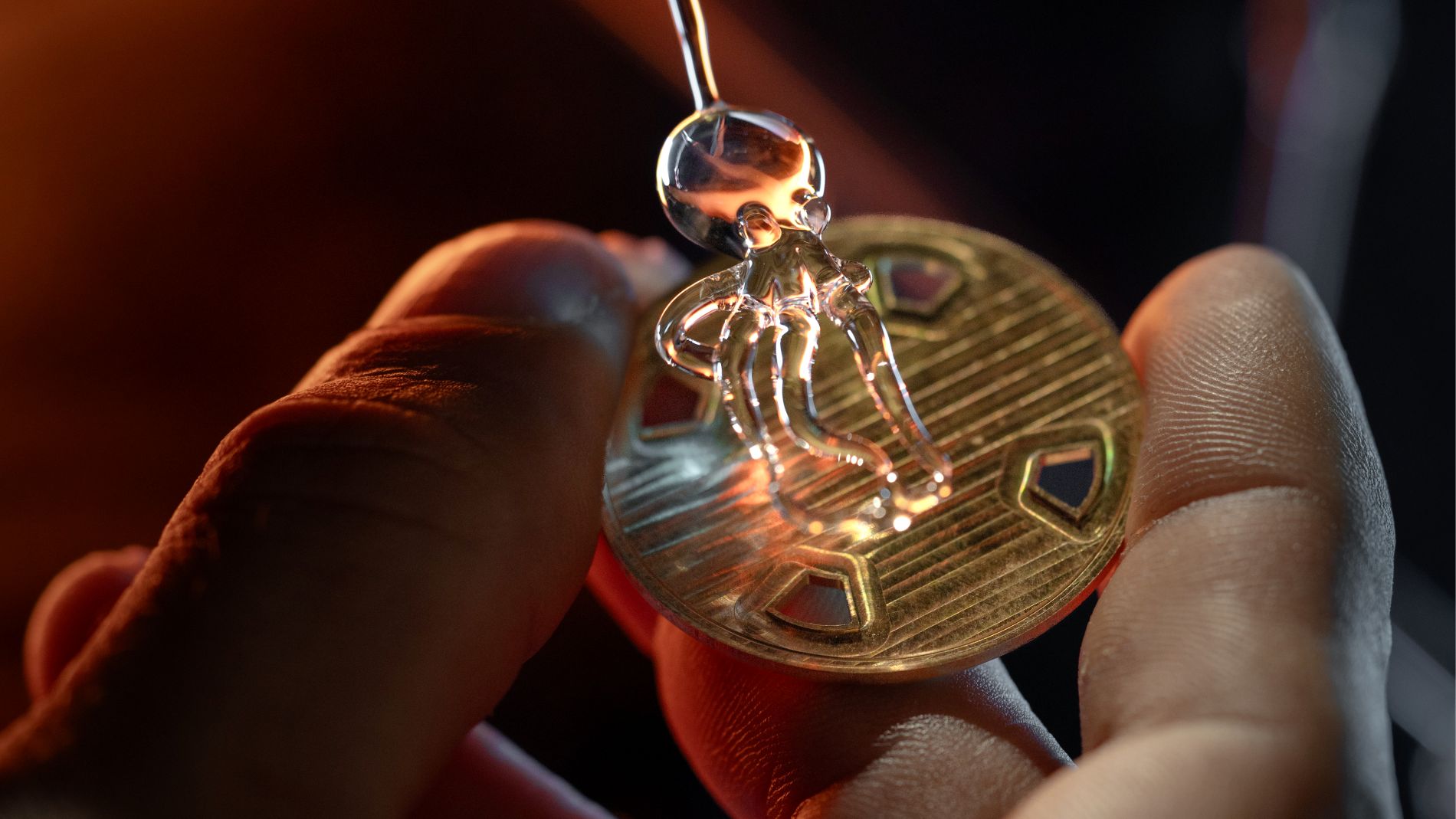
The creature, intricately sculpted entirely from transparent glass, rises only 3.5 millimetres above the dial, making it a truly remarkable miniature glass sculptures ever created. This achievement, particularly in a craft where mastery is traditionally associated with large and often theatrical volumes, necessitated the development of a new technique. This innovative approach was specifically designed to translate a complex 3D form into a delicate 2.5D sculpture, while meticulously achieving the final esthetic goal. The intricate process involved melting tiny glass rods and shaping them with tungsten tools, proceeding piece by piece in a method akin to a highly manual form of 3D printing. Each tentacle and every individual sucker of the octopus had to be constructed gradually, dot by dot, since reheating such fine threads of glass would otherwise cause them to collapse into tiny spheres through surface tension.
Tungsten tools specifically created for this project enabled impressing the glass to achieve the fine details of the face and suckers without melting entire segments of the sculpture.
The choice of transparent glass was a complication in itself: every thickness, overlap, and refraction had to be carefully considered, as glass magnifies and distorts whatever lies behind it. This is why carefully constructed optical illusions were created to mimic tentacles crossing over one another, precisely to avoid distortions that would have compromised the aesthetic harmony.
Integrating the microscopic sculpture within the dial architecture became part of the challenge. Two sections of the tentacles had to pass just above the four apertures displaying the hours, minutes, day and date, whose windows rise only two-tenths of a millimeter above the dial surface. This minute constraint ultimately guided the final positioning of the octopus.
The development process lasted more than a year, with the first prototypes in spring 2025. Each individual prototype required at least three days of work. The final batch consisted of four slightly different octopuses, each with subtle variations in movement, from which the final version was selected.
To secure this timepiece to the wrist Vacheron Constantin’s watchmakers have designed a blue calf leather strap featuring embossed octopus tentacles’ details echoing the dial motif.
INTERVIEW WITH THE ARTIST SIMONE
CRESTANI – GLASSOCTOPUS
What was the most unexpected challenge in this project?
Without doubt, the scale of the project. In glassmaking, one usually thinks in centimeters, sometimes even in monumental volumes, whereas here everything had to be controlled to the tenth of a millimeter. Although I had previously created minute glass details, including bees adorning a Venetian-style goblet presented at a previous edition of Homo Faber, nothing had approached the microscopic scale required for this dial. This forced me to completely rethink my technique and adapt all my tools to ensure that every detail remained readable and alive within the dial’s dimensions, while still giving the octopus a sculptural presence and a sense of movement, as if floating underwater.
What does this project represent for you personally?
This project constitutes a real turning point in my work because it forced me to develop a new technique that I had never used in twenty-five years of working with glass. It opened a new perspective in my practice, making me realize that I can now apply this knowledge to create even smaller, more intricate elements in future works. I am proud to have completed it because making something so small ultimately proved as demanding as creating something monumental, which is typically considered the greatest challenge for a glassmaker.