
Patek Philippe presents its iconic travel watch in a first version in yellow gold with a carmine-red dial and non-gem-set bezel, Reference 7129J-001. This timepiece is the latest addition to the World Time watch family. Its mechanism made its debut in the 1930s, the era of the first transatlantic flights, based on an invention by the Geneva master watchmaker Louis Cottier. It has benefited from continual technical optimizations ever since. As from the early 1950s, this mechanism makes it possible to read off the time simultaneously and permanently in all 24 time zones, by means of two mobile disks (a city disk and a 24-hour disk) while also having the advantage of a local-time display (in a time zone selected at the 12 o’clock position) by center hour and minute hands. This ingenious system, combined with dial centers adorned with colorful maps in Grand Feu cloisonné enamel or with hand-executed guilloché decorations, has made this complication one of the most recognizable of Patek Philippe models –and one of the most sought after by devotees of splendid mechanisms.
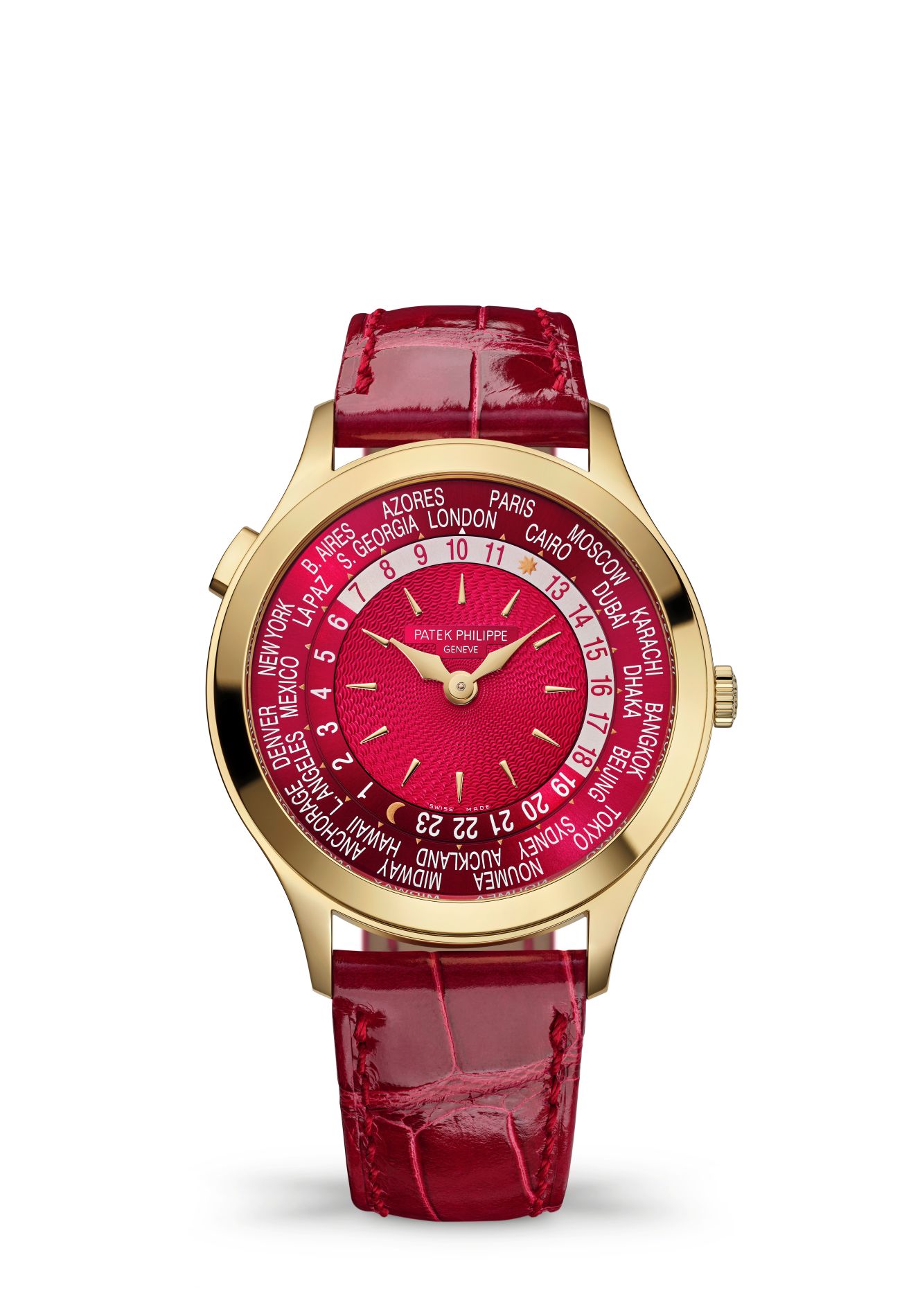
In the new Reference 7129, the fully polished case in yellow gold, 36 mm in diameter, combines its warm luster with a bold, red-lacquered dial, centering delicate hand-executed guilloché work in a basket-weave pattern, framed by arrow-shaped hour markers, also in yellow gold. The 24-hour disk is divided into a day zone and a night zone, identified by their backgrounds in carmine red and rhodium-plated gray respectively, as well as by their Sun and Moon symbols. Yellow-gold lozenge-shaped hands indicate local time in the selected time zone at 12 o’clock, while the names of the 24 cities are transfer-printed in white on the carmine-red disk. The striking allure of this watch is enhanced by its curved lugs holding an alligator leather strap in shiny carmine red, secured by a prong buckle in yellow gold.
This timepiece is powered by the caliber 240 HU ultra-thin self-winding movement. Equipped with a mini-rotor, this movement keeps the case to a super-slim 8.83 mm thickness despite its 239 parts.
In 2000, the Geneva workshops took the functionality of this watch a step further by integrating a single-button mechanism to advance all the displays collectively when moving from one time zone to another – without affecting the rate accuracy of the movement by even one second. It took four years to develop this mechanism, patented in 1999, which bolstered the popularity of the World Time watch on all continents.
The new Reference 7129J-001 joins the current collection alongside Reference 7130G-016 in white gold with a gem-set bezel and blue-gray dial.