
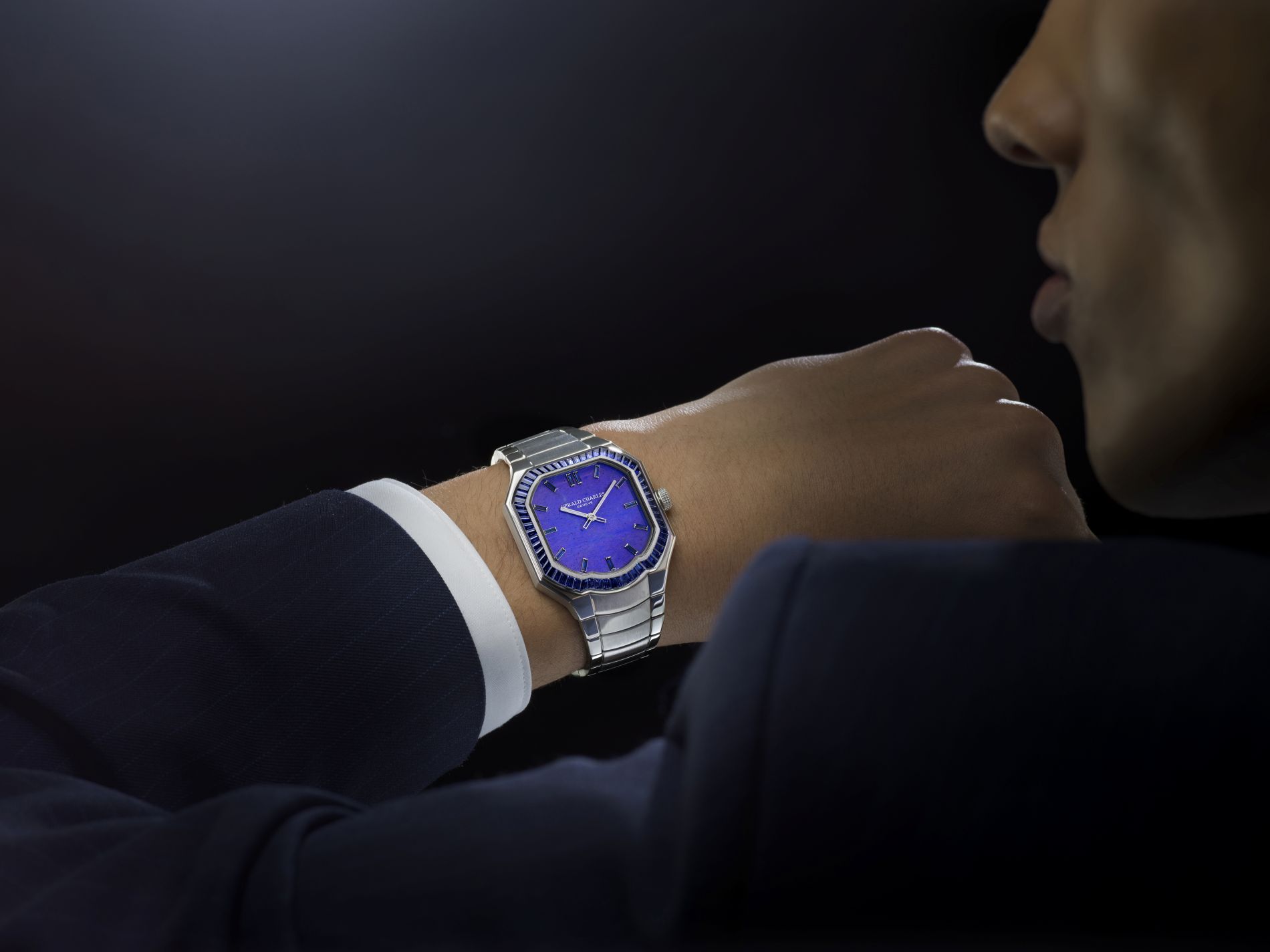
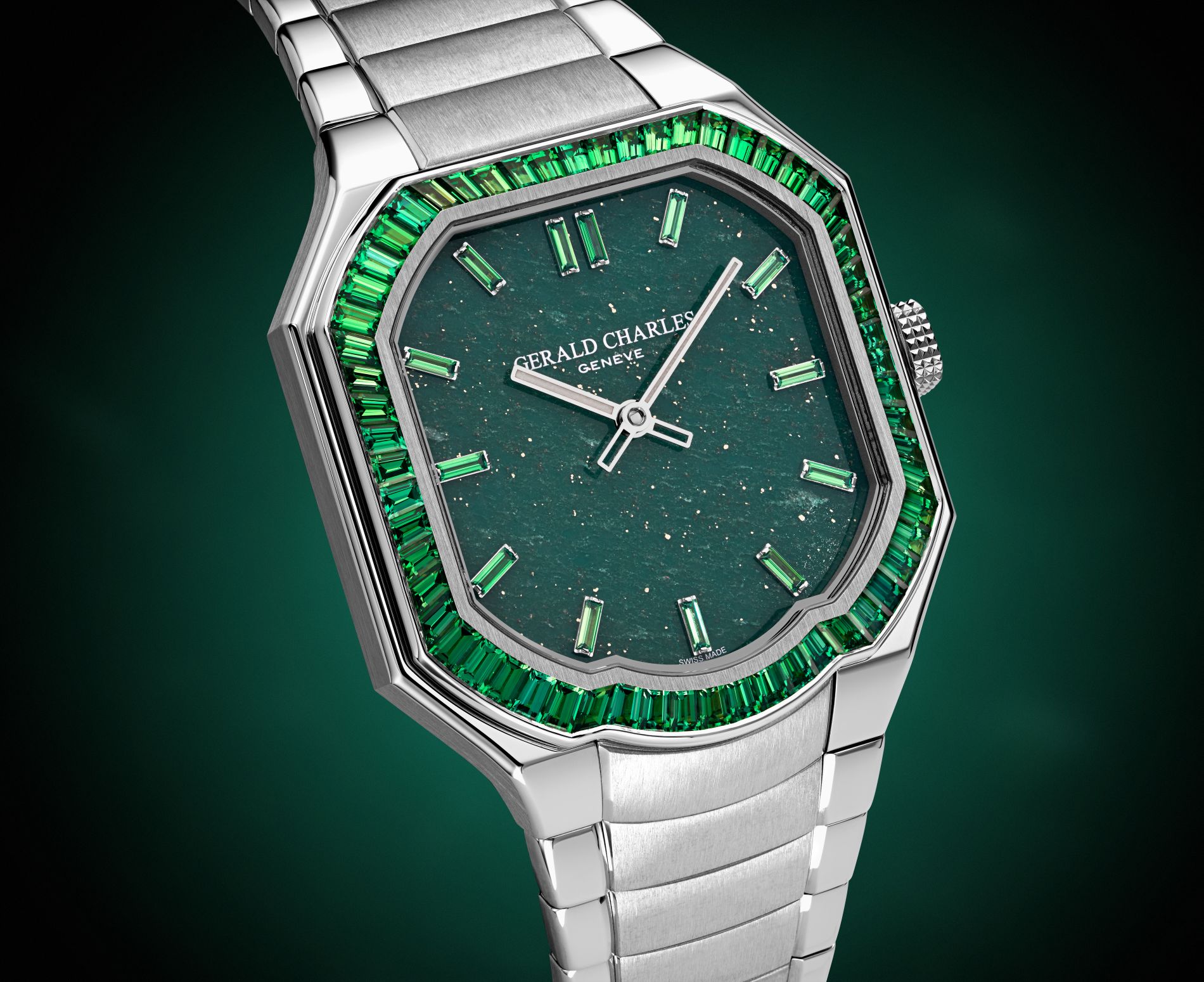
Gerald Charles introduces the Masterlink Gem Set Stone Dial, a trio of limited editions that brings the raw beauty of natural stone to the Maison’s signature asymmetrical case. The watches feature a white gold bezel set with 60 baguette-cut blue and red sapphires or tsavorites, framing each dial in a fitting complement to the stones within. Each dial is cut from a mineral chosen not only for its visual character, but for the sheer difficulty of transforming it into a wearable work of art.
Stone dials are not new in the Gerald Charles collection – they represent a return to form. Gérald Charles Genta was famous for his appetite for experimentation, and few materials captured that spirit better than natural stone: unpredictable, alive with colour, and impossible to fully control. The Masterlink Stone Dial continues that tradition, pairing the founder’s love of the unexpected with the technical precision of the modern Maison.
A Shape That Allows No Compromise
The Masterlink’s identity lies in its asymmetry – most visibly in the signature “smile” at 6 o’clock. On a conventional round dial, a stone blank can simply be cut to diameter. On the Masterlink, the stone must be shaped to follow that same sculptural curve, with no room to hide an imperfection at the very point where the eye is drawn.
Stone does not bend to a template: cutting a rigid, unpredictable material to an irregular silhouette – rather than a forgiving circle-multiplies the risk of breakage at every stage, and demands a precision that only hand craftsmanship can deliver.
Twenty-Four Hours, One Dial
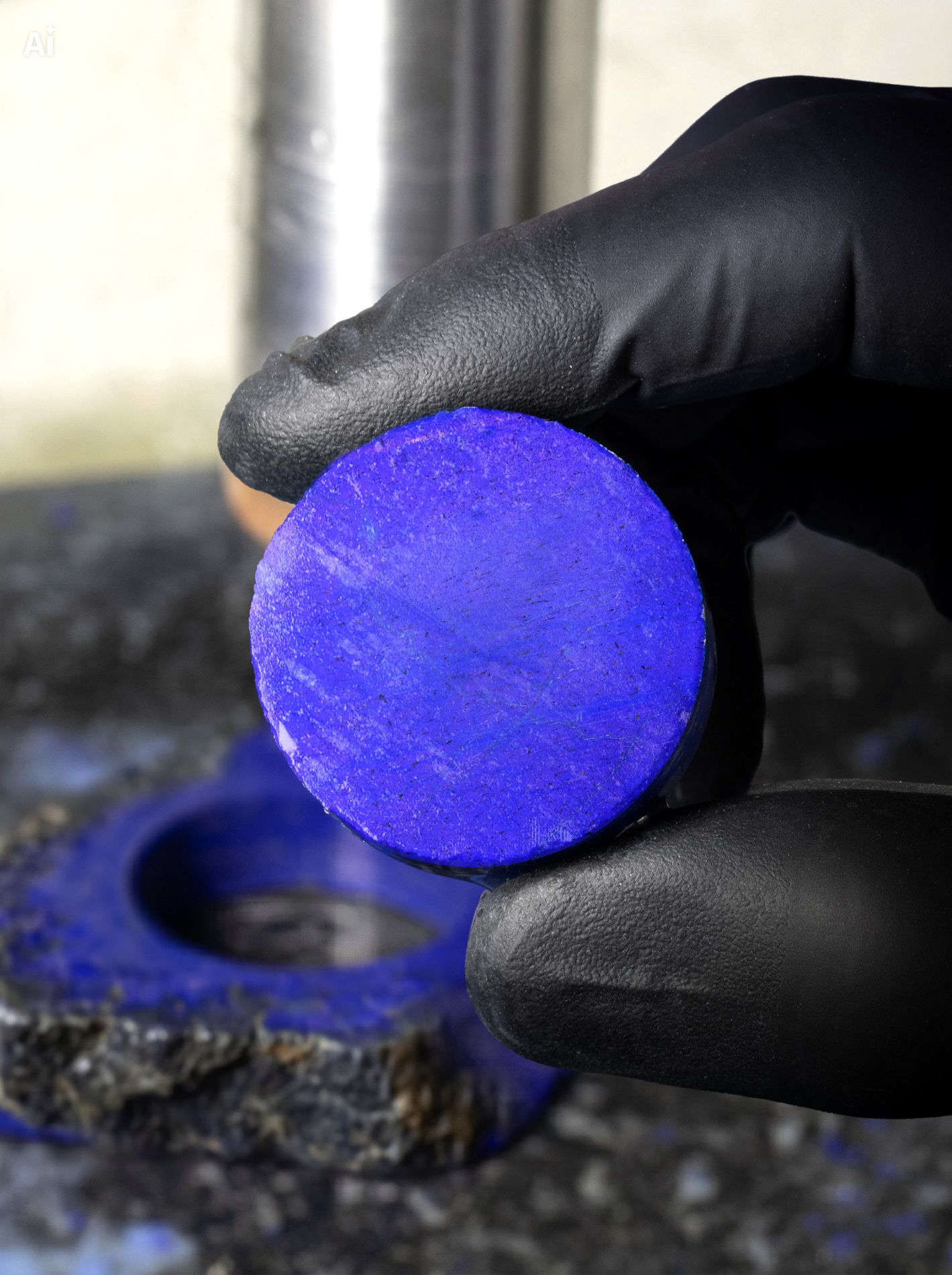
Behind every Masterlink Stone Dial lies a process that tests patience as much as skill. It begins blind: until the first cut is made, no one can know the exact colour hidden inside the stone. Each block is sliced into 5mm sections to reveal its tone, its impurities, and the zones worth pursuing – a search for consistency in a material that offers none by nature.
From there, the stone is cut to its asymmetrical form, then hand-polished down to 1mm, then further refined to a fragile 0.55mm – thinner than a credit card, and just as easy to break, now in a shape with no straight edges to simplify the work. The numbers tell their own story: for a production run of 50 dials, 150 are selected to survive the process. Roughly one in ten is lost at the polishing stage. During machining alone, when the dial, brass base, and applique are shaped and the stone ground to its final silhouette, losses climb as high as 65%. Every survivor is then inspected, hand-assembled with the utmost care to avoid a single scratch, and finished with the Gerald Charles logo – more than a 24-hour journey from raw mineral to finished dial, repeated one piece at a time, with no guarantee of success until the very end.
AVENTURINE – Brazil
Formed over geological time as quartz-rich rock is compressed and heated deep within the Earth’s crust, aventurine owes its shimmer to countless microscopic mineral inclusions suspended within a dense, stable structure.
That same density makes it demanding to cut: precise control is required to preserve the sparkle without fracturing the stone, resulting in a dial that shifts between quiet depth and sudden brilliance – a night sky captured in mineral form.
SPECTROLITE – Finland
A rare variety of labradorite, Spectrolite forms in ancient igneous rock from the slow cooling of magma. Its vivid blues, greens, golds, and violets come not from pigment but from ultra-fine internal layers that refract light a phenomenon known as labradorescence. Cutting the dial to the correct angle is critical: shift the orientation by even a fraction, and the colour show disappears. Get it right, and the dial comes alive with every turn of the wrist.

IRON EYE – South Africa
Iron Eye is born from iron- and silica-rich deposits compressed and recrystallized over nearly 2.5 billion years, producing a banded structure of hematite, jasper, and tiger’s eye. Its hardness and mixed composition make it one of the most technically demanding stones to cut cleanly – a single dial can reveal three different mineral densities within one surface. The result is a striking, unrepeatable cross-section of deep time.
No two dials are ever alike
Each one preserves the natural variations, reflections, and irregularities of its stone – a distinctive identity, and a geological story million, sometimes billions, of years in the making. Each of the three dials is offered as a limited edition of 10 pieces, for a total of 30 timepieces worldwide.
“Gérald was never afraid of a material that couldn’t be controlled – stone excited him precisely because every piece had a mind of its own,” says Federico Ziviani, CEO of Gerald Charles.
“With the Masterlink Gem Set Stone Dial, we’ve brought that same spirit into a case he never had the chance to design for.”